
Photos By Chase White
Advertisement
Imagine standing in an open field on a crisp autumn morning, a peregrine falcon circling high overhead. You move through the grass, hoping to flush a game bird into the air. When the opportunity presents itself, the falcon folds its wings and plummets toward its quarry with astonishing speed. The entire encounter may last only seconds, but behind it lie countless hours of training, preparation and observation.
Advertisement
This is falconry, a form of hunting that has been practised around the world for thousands of years and continues to find devoted enthusiasts in British Columbia.
Advertisement
Unlike most modern hunting methods, falconry relies on the natural abilities of another predator. The falconer must learn to work with an animal that retains its wild instincts, developing a partnership that allows both hunter and bird to do what neither could accomplish as effectively alone.
An Ancient Hunting Tradition
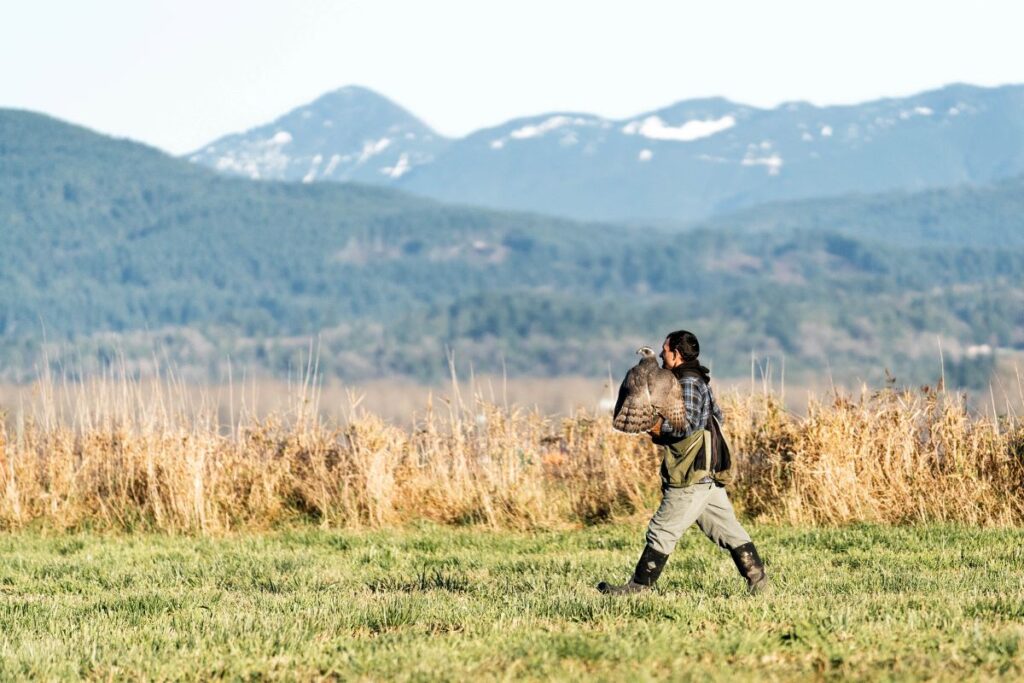
Falconry predates the invention of firearms by centuries. Originally practised in part as a means of obtaining food, it evolved into a hunting tradition throughout Asia, the Middle East, Europe and eventually other parts of the world.
Its cultural significance is such that UNESCO has recognized falconry as an element of the Intangible Cultural Heritage of Humanity.
Although modern equipment has made certain aspects of falconry easier, the fundamentals remain remarkably unchanged. A falconer must understand the behaviour, instincts, physical condition and individual personality of their hunting companion. There are no shortcuts to developing that understanding.
Choosing A Hunting Partner
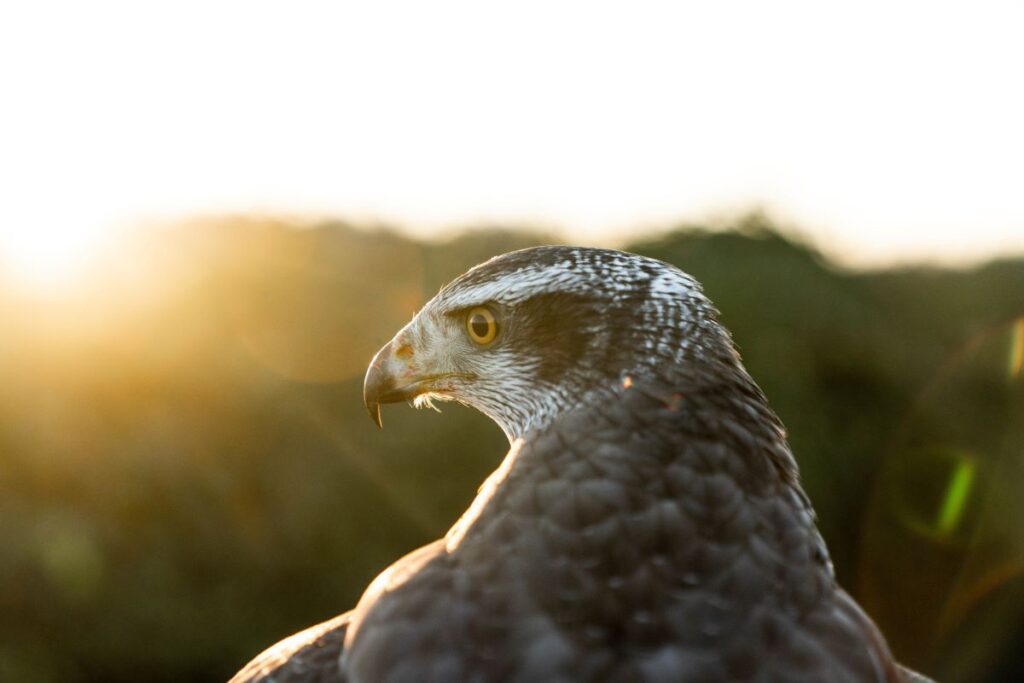
Despite its name, falconry isn’t limited to falcons. Hawks and other birds of prey can also be trained for hunting, with different species suited to different terrain and quarry.
Peregrine falcons are particularly impressive aerial hunters, capable of exceeding 300 kilometres per hour during a hunting dive, known as a stoop. Their speed makes them well suited to pursuing game birds in open country.
Gyrfalcons, the largest falcon species in the world, are powerful hunters native to northern environments, including parts of BC Northern goshawks, meanwhile, possess relatively short wings and long tails that allow them to manoeuvre through wooded environments in pursuit of prey.
Red-tailed hawks are well suited to hunting small mammals, while Harris’s hawks, native to warmer regions of the Americas, are unusual among raptors for their cooperative hunting behaviour. Their social nature makes them popular among falconers.
Choosing a bird involves considering everything from available hunting grounds and local quarry to the falconer’s experience and ability to meet the bird’s needs.
Building A Partnership
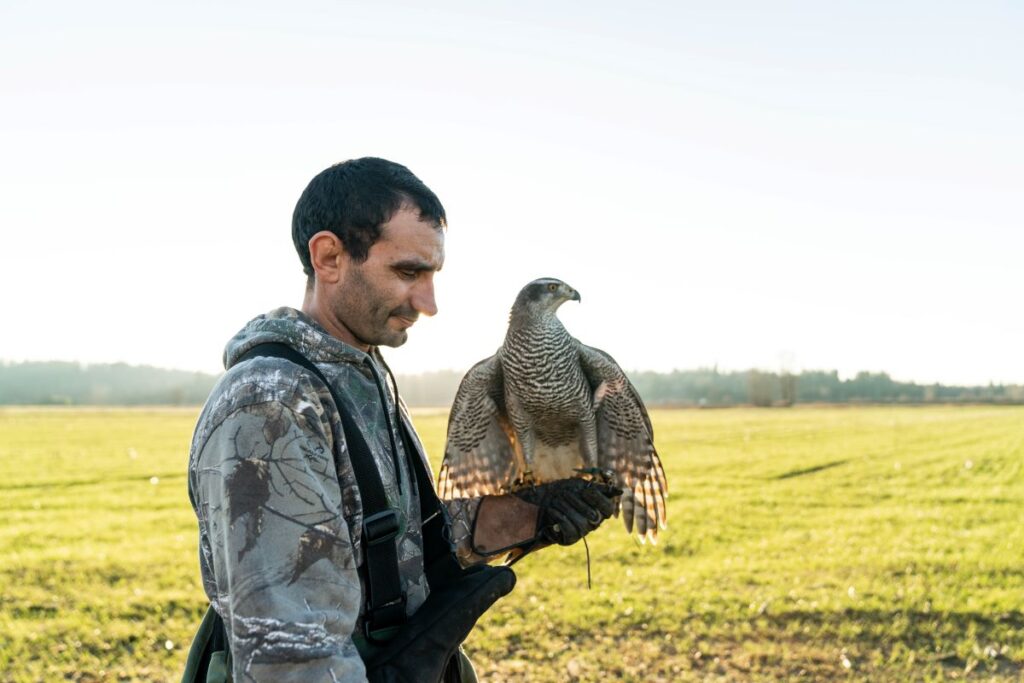
One of the most remarkable aspects of falconry is that a trained bird, once released, is physically capable of flying away.
Training relies heavily on positive reinforcement through food rewards. Over time, the raptor learns to associate its handler with opportunities to feed and hunt. The falconer gradually introduces the bird to increasingly challenging flights before progressing to hunting wild quarry.
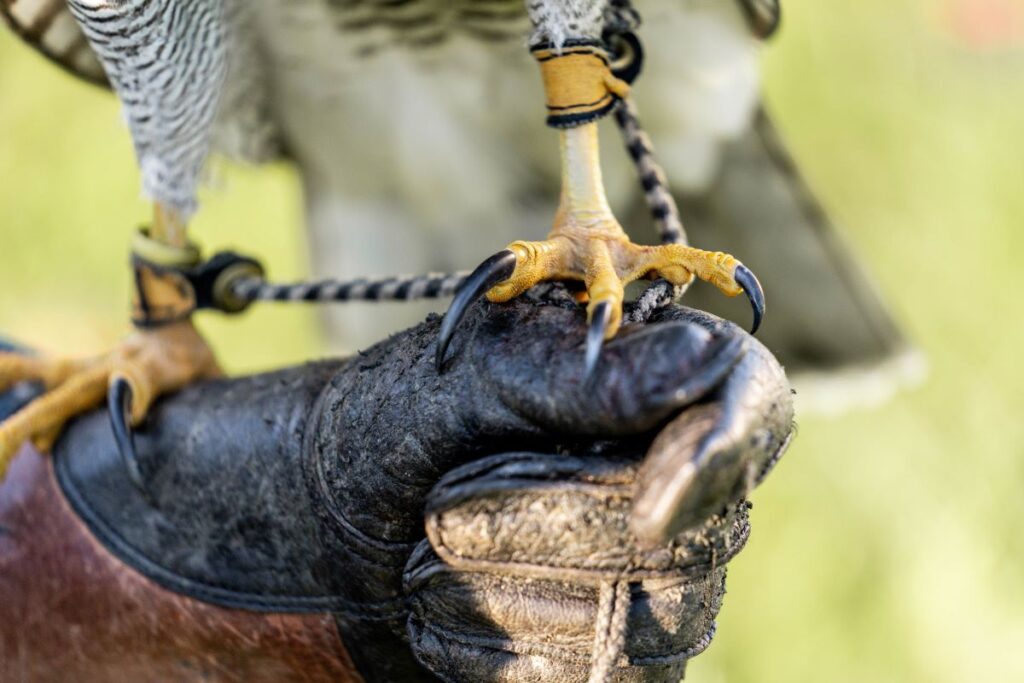
Falconers use several pieces of specialized equipment, some of which have existed in various forms for centuries. A heavy leather glove protects the handler from sharp talons, while leather straps called jesses help secure the bird when necessary. A hood may be used to reduce visual stimulation, and a lure is used during training and to recall a flying bird.
Modern technology has also found its place in the sport. Lightweight radio transmitters and GPS tracking devices allow falconers to locate birds that travel beyond their field of vision.
The responsibilities extend well beyond hunting season, however. Raptors require appropriate housing, specialized diets, regular health monitoring and veterinary care. Their feathers must be maintained in good condition, as damaged flight feathers can compromise their ability to hunt.
For dedicated falconers, caring for a bird becomes a year-round lifestyle rather than a seasonal pastime.
Hunting BC’s Diverse Landscapes
British Columbia’s varied geography lends itself to several styles of falconry. Agricultural fields, open grasslands, wetlands and forest edges all provide different hunting opportunities.
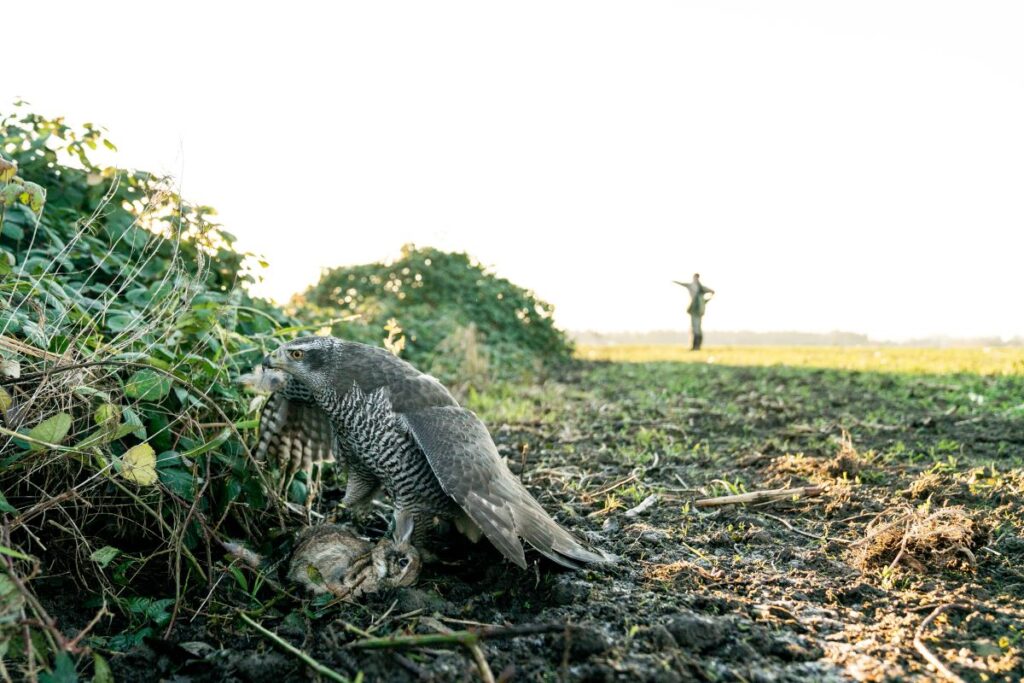
A falconer pursuing ducks might fly a peregrine over open country, allowing the bird to gain altitude before flushing the quarry. Someone hunting rabbits with a hawk might instead work through brushy areas, with the bird following from nearby perches.
Success is far from guaranteed. Wild prey has evolved sophisticated strategies for avoiding predators, and even experienced hunting birds frequently return empty-taloned.
Falconry also encourages hunters to pay particular attention to their surroundings. Wind direction, vegetation, temperature, terrain and the presence of other predators can all influence a hunt. Power lines, roads and fences present additional hazards that must be considered before releasing a bird.
A Connection To Conservation
The history of modern falconry is closely intertwined with one of North America’s most remarkable wildlife recovery stories.
During the mid-20th century, peregrine falcon populations declined dramatically as pesticides such as DDT accumulated through the food chain, causing eggshell thinning and reproductive failure.
Restrictions on these chemicals, combined with captive breeding and reintroduction programs, helped peregrine populations recover across much of North America. Falconers contributed valuable knowledge of raptor husbandry, breeding and behaviour to these recovery efforts.
British Columbia is also home to a particularly interesting subspecies, Peale’s peregrine falcon. Found along the Pacific coast, including Haida Gwaii, these falcons frequently prey on seabirds and have adapted to life in the province’s rugged coastal environments.
Protecting healthy ecosystems and abundant prey populations remains important to the future of both wild raptors and recreational falconry.
The practice is not without controversy. Animal welfare organizations, including the BC SPCA, have raised concerns about captive raptor husbandry, training methods and the welfare of hunted animals. Responsible bird care and adherence to wildlife regulations are essential considerations for anyone entering the sport.
Falconry Beyond The Hunt
The skills developed through falconry have found some surprisingly modern applications.
At airports, trained birds of prey can help discourage gulls, geese and other birds from congregating near runways, reducing the risk of collisions with aircraft.
Based in Duncan on Vancouver Island, The Raptors provides professional wildlife management services that incorporate trained raptors alongside other wildlife deterrence methods. Similar techniques can be used at industrial facilities, waste management sites and urban locations where large concentrations of birds create problems.
In these settings, the presence of a natural predator can be enough to encourage other birds to move elsewhere.
It is a fascinating example of how an ancient practice continues to serve a purpose in the modern world.
Becoming A Falconer In British Columbia
Falconry is regulated under BC’s wildlife legislation. Prospective falconers must obtain the appropriate provincial permits to possess birds of prey, and capturing a wild raptor requires separate authorization. Hunters must also hold the applicable hunting licences and follow species-specific seasons, bag limits and regional restrictions. A federal migratory game bird hunting permit is required when hunting regulated migratory game birds.
Anyone interested in pursuing the sport would be wise to begin by contacting the BC Hawking Club, which connects falconers throughout the province.
Spending time with an experienced falconer and observing hunts before acquiring a bird can provide invaluable insight into the commitment involved. The Raptors in Duncan also offers educational opportunities and falconry courses covering aspects of raptor handling, training and hunting.
Falconry requires considerably more preparation and daily responsibility than many other outdoor pursuits, but it also offers an extraordinary way to experience the natural world.
There is something remarkable about watching a bird of prey disappear into the open sky, knowing that after thousands of years of human technological advancement, one of our oldest hunting traditions still depends on little more than patience, understanding and the instincts of a remarkable predator.