

When most hunters picture black-tailed deer habitat, they imagine dense coastal rainforests, thick salal, moss-covered timber and narrow game trails winding through the undergrowth. Sandy beaches, rocky shorelines and piles of washed-up seaweed probably aren’t the first places that come to mind.
Advertisement
But along British Columbia’s rugged Pacific coastline, black-tailed deer are making use of an environment that many hunters might overlook: the narrow strip of land between the forest and the sea.
Advertisement
A recent study conducted in Barkley Sound, on the west coast of Vancouver Island, has revealed some fascinating details about how deer and other terrestrial wildlife use coastal shorelines. The findings suggest these areas are more than simply boundaries between land and ocean. For many animals, they’re important travel corridors, occasional feeding grounds and places where predators and prey cross paths.
Advertisement
And for hunters interested in understanding the habits of BC’s elusive coastal blacktails, the research offers a different perspective on familiar territory.
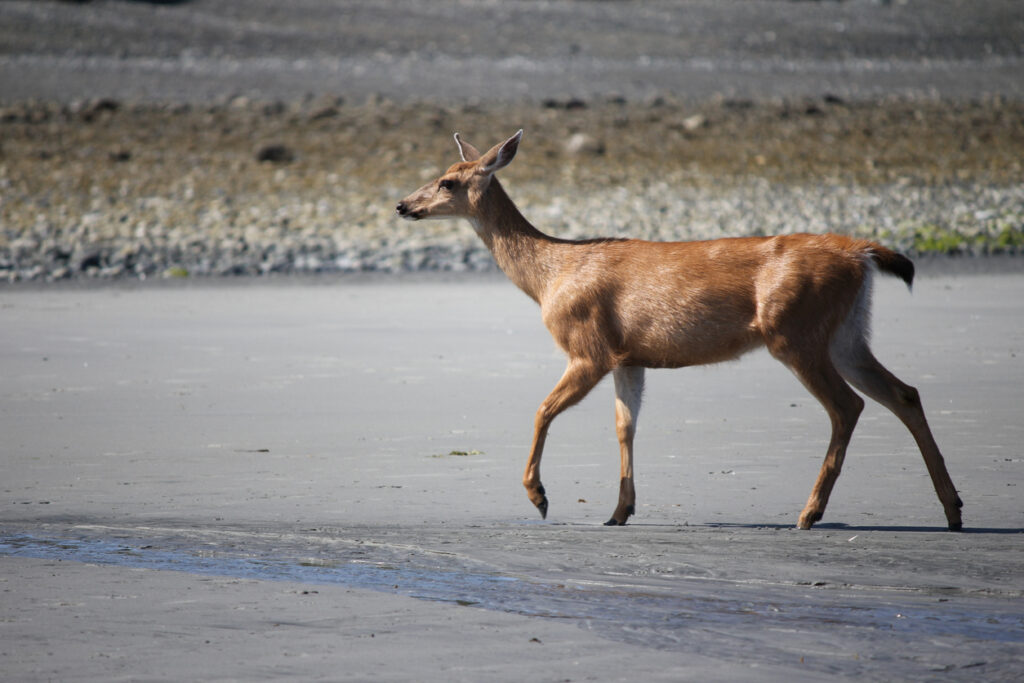 Photo by iStock
A Different Kind Of Deer Trail
Between March and December 2024, researchers installed 39 motion-activated cameras along intertidal shorelines in Barkley Sound, an area known for its sheltered bays, rocky beaches, islands and coastal rainforests.
The cameras were positioned near the high-tide line, where the forest meets the shore, and programmed to capture wildlife activity throughout the day and night.
The resulting study, published in September 2026 in Estuarine, Coastal and Shelf Science, documented 3,313 independent wildlife detections representing 11 mammal species and 12 bird families.
Among the mammals recorded were black bears, raccoons, wolves, cougars, Roosevelt elk and black-tailed deer.
Black bears were by far the most frequently detected mammals, but black-tailed deer weren’t far behind in their distribution across the study area. Researchers recorded 161 independent deer detections at 18 of the 38 camera stations included in the final analysis.
What made those observations particularly interesting wasn’t simply the presence of deer along the shoreline, but what the animals were doing there.
An impressive 91 per cent of recorded deer activity involved travelling. Only six per cent involved feeding, while the remaining three per cent consisted of resting.
Rather than visiting beaches primarily to eat, the deer appeared to be using them as convenient routes through the coastal landscape.
The Path Of Least Resistance
Anyone who has hunted Vancouver Island blacktails knows just how challenging their habitat can be. Dense vegetation, fallen timber, steep slopes and tangled undergrowth can make moving through the forest difficult.
For deer, the shoreline may offer an easier alternative.
Compared with pushing through thick brush, travelling along an open beach or rocky stretch of coastline can provide a relatively unobstructed route between sections of forest.
The researchers suggested that deer may use these shorelines opportunistically as pathways offering less resistance to movement.
It’s an interesting possibility, particularly in areas where rugged terrain or dense vegetation restricts travel farther inland.
However, the study also uncovered something unexpected about the relationship between deer movement and the tides.
While black bears were most frequently detected when water levels were low, black-tailed deer showed no clear preference for a particular tidal stage.
Their shoreline activity didn’t appear to depend strongly on whether the tide was in or out.
This distinction suggests that deer aren’t necessarily waiting for exposed beaches to appear before moving through an area. Instead, they may be taking advantage of accessible shoreline routes whenever conditions allow.
The cameras couldn’t track individual deer beyond their field of view, so researchers couldn’t determine how far the animals travelled along the coast or exactly where they were headed. Nevertheless, the observations provide compelling evidence that beaches can form part of the routes deer use to move through coastal habitat.
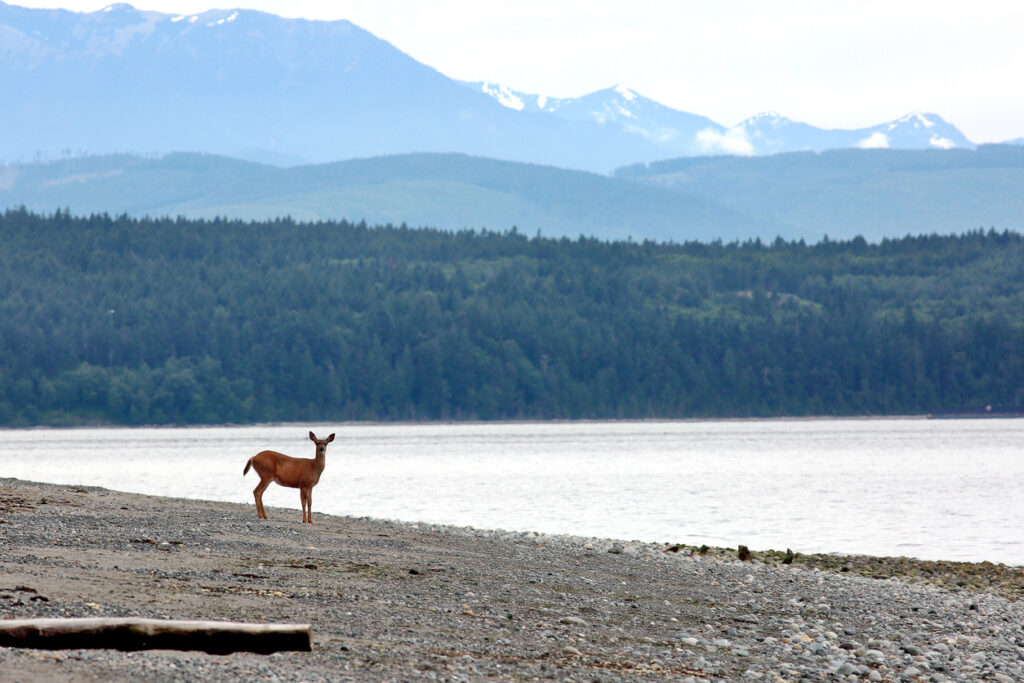 Photo by iStock
What’s On The Menu?
Although travelling accounted for most shoreline deer activity, researchers also recorded occasional feeding.
Coastal deer are known to consume a variety of vegetation, and the upper intertidal zone can offer some unusual additions to their diet.
Shoreline grasses, washed-up marine vegetation and seaweed are among the potential food sources available where the forest meets the ocean.
For deer accustomed to browsing terrestrial plants, these coastal resources provide an opportunity to feed outside their usual forest habitat.
Interestingly, separate research published in Peer Community Journal in 2025 examined how predation risk influences deer behaviour in Haida Gwaii and other coastal areas of BC.
Using evidence that included chemical signatures preserved in deer bones, researchers investigated the role of marine foods in deer diets.
They found that deer living in areas with greater exposure to predators or hunting pressure were less likely to feed in intertidal habitats.
The findings suggest that food availability isn’t the only factor determining whether a deer ventures onto the beach. Its perception of danger may be just as important.
An exposed shoreline might offer an easy meal, but it can also leave a deer more visible and potentially vulnerable.
Sharing The Shoreline With Predators
Black-tailed deer aren’t the only animals using these coastal routes.
The Barkley Sound study also recorded wolves and cougars moving through intertidal areas, raising interesting questions about how predators and prey use the same narrow strips of habitat.
Researchers found considerable overlap between the daily activity patterns of wolves and deer. Both species were most active around dawn and dusk, the transitional periods known as crepuscular hours.
That overlap doesn’t necessarily mean wolves were actively hunting deer on the beaches, or that encounters were more frequent. The cameras recorded activity at different places and times, not direct evidence of increased predation.
Still, the shared use of these environments is noteworthy.
Coastal wolves are capable of travelling along shorelines and swimming between islands, and previous observations have documented wolves pursuing deer toward the water.
Cougars were also recorded during the study, although their shoreline activity was concentrated more heavily during nighttime hours.
For deer, navigating coastal habitat means balancing the benefits of an accessible travel route against the possibility of encountering predators.
That balance may help explain why some deer readily venture onto exposed beaches while others remain closer to the security of the forest.
What Can Hunters Learn?
Although the Barkley Sound research wasn’t designed to investigate hunting behaviour, its findings offer several interesting considerations for coastal blacktail hunters.
Perhaps the most important is that deer movement doesn’t always follow the routes we expect.
Hunters often concentrate on forest trails, bedding areas, feeding sites and openings in the timber. While these remain important places to look for blacktails, the research suggests that accessible shorelines and the transition zones between beaches and forest deserve attention as well.
An isolated beach, sheltered bay or narrow strip of accessible shoreline could provide a natural travel route through otherwise difficult terrain.
The study’s findings also reinforce the importance of understanding daily movement patterns.
Black-tailed deer were most active around dawn and dusk, consistent with the behaviour hunters commonly associate with deer. However, the research doesn’t establish that those periods will always produce the best hunting opportunities at a particular location.
Similarly, the absence of a strong relationship between deer activity and tidal height suggests that hunters shouldn’t assume low tide is necessarily the best time to find deer along the coast.
Local terrain, access routes, vegetation and signs of recent activity remain important considerations when assessing an area.
Of course, not every coastal shoreline is open to hunting. Park boundaries, private property, local restrictions and seasonal regulations must all be considered before planning a hunt.
Perhaps the greatest value of the research is the reminder that deer habitat extends beyond the places where we usually expect to find these animals.
More Than A Boundary
BC’s coastal ecosystems are remarkably interconnected. Nutrients move between ocean and forest, terrestrial predators take advantage of marine food sources, and animals regularly cross the boundary between these two environments.
The Barkley Sound study adds another piece to that picture.
For black bears, exposed shorelines can be productive feeding grounds. For raccoons, they offer opportunities to search for food among the rocks and vegetation. For black-tailed deer, they appear to serve primarily as pathways through a complicated landscape.
Much remains to be learned about how frequently individual deer use these routes, whether shoreline travel changes with the seasons and how predators influence their movements.
But one thing is becoming increasingly clear: the coastal forest doesn’t simply end at the beach.
For BC’s black-tailed deer, the shoreline is another part of their home range, and sometimes the most interesting deer trail is the one that follows the sea.