

A flock of Canada geese approaches a quiet lake, wings beating steadily as the birds prepare to land. Then, without warning, one goose appears to lose control. It tips sideways, twists its body and drops sharply toward the water. Another follows, rolling almost upside down before suddenly straightening out and gliding to a gentle landing.
Advertisement
From the ground, it looks like an aerial disaster unfolding. In reality, the birds know exactly what they’re doing.
Advertisement
The manoeuvre is called whiffling, and it’s one of the more remarkable tricks in a goose’s flying repertoire. By deliberately disrupting the airflow over their wings, geese can shed lift, lose altitude rapidly and make dramatic course corrections that seem to defy the laws of flight.
Advertisement
It’s a useful skill for a large bird that needs to get from cruising altitude to a particular patch of water or field without making a long, gradual approach.
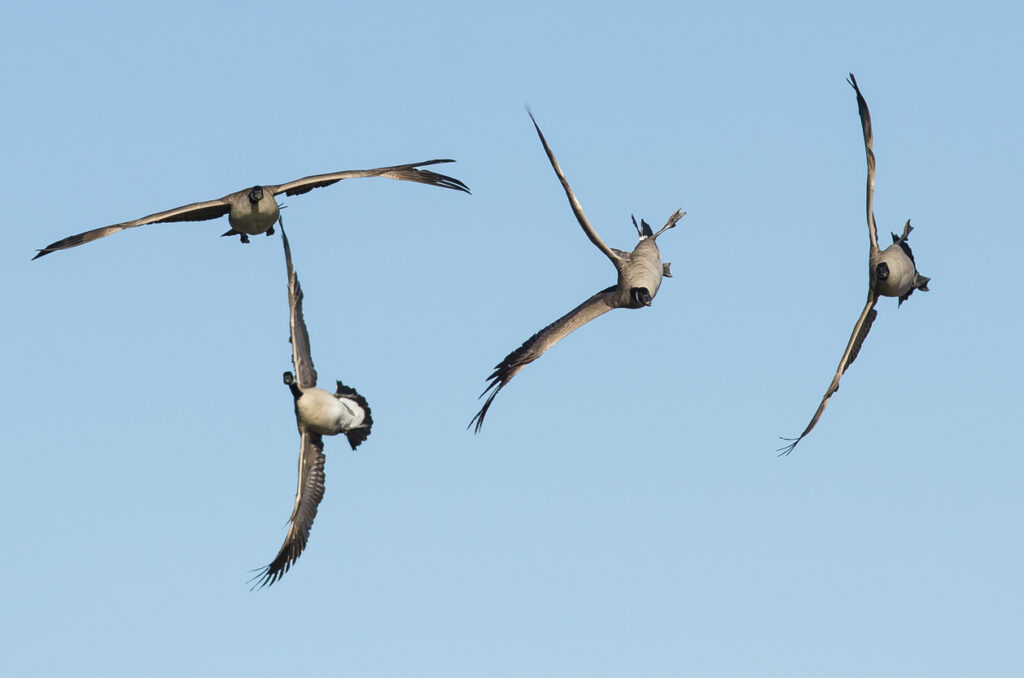 Photo by iStock
The Art Of Falling Without Falling
Canada geese are powerful fliers, capable of travelling considerable distances on broad, muscular wings. But while those wings are excellent for staying airborne, getting back to the ground quickly presents a different challenge.
Under normal flight conditions, a goose’s wings generate lift as air moves around them. To descend, the bird must reduce that lift or adjust its flight path. Usually, this happens gradually, with changes in wing position and speed allowing for a controlled approach.
Whiffling takes a more dramatic approach.
The goose may stop flapping, bank sharply from side to side or roll its body until it is almost completely inverted. In some cases, the bird turns upside down while twisting its long neck to keep its head upright.
This unusual position changes the way air flows across the wings, reducing their ability to generate lift. The goose can then descend much more steeply than it would in an ordinary glide.
To an observer, the movement can resemble a falling leaf, a tumbling aircraft or a bird suddenly dropping out of the sky.
But the descent is controlled. At the appropriate moment, the goose rights itself, restores normal airflow over its wings and resumes flying.
The entire sequence may last only a few seconds.
How Does Whiffling Work?
The secret lies partly in the structure of a bird’s flight feathers.
Unlike the rigid wings of an aircraft, a goose’s wings are made up of individual feathers that can flex, twist and separate in response to airflow.
During normal flight, overlapping feathers help form an aerodynamic surface that produces lift. When a goose rolls upside down, however, airflow can cause its primary flight feathers to twist apart, opening gaps through which air can pass.
These gaps are believed to contribute to the loss of lift that makes a rapid descent possible.
Researchers at the University of Michigan have investigated this mechanism, examining whether feather-inspired gaps could improve the control of small aircraft.
In a 2022 study published in Bioinspiration & Biomimetics, researchers tested specially designed wings with gaps along their trailing edges. Although the gaps were not as effective as conventional aircraft spoilers for reducing lift, they demonstrated considerable potential for controlling how an aircraft rolls.
The research highlights the sophistication of a manoeuvre that geese perform without mechanical controls or onboard computers.
There’s an important distinction, however, between what whiffling looks like and what it actually accomplishes.
A goose may appear to stop in mid-air before dropping almost vertically, but it has not truly suspended itself motionless. Instead, it is changing its orientation, lift and flight path very quickly. Wind conditions and viewing angles can make this sudden change particularly deceptive.
And despite appearances, whiffling is not an uncontrolled free fall. The bird remains capable of correcting its position and returning to normal flight.
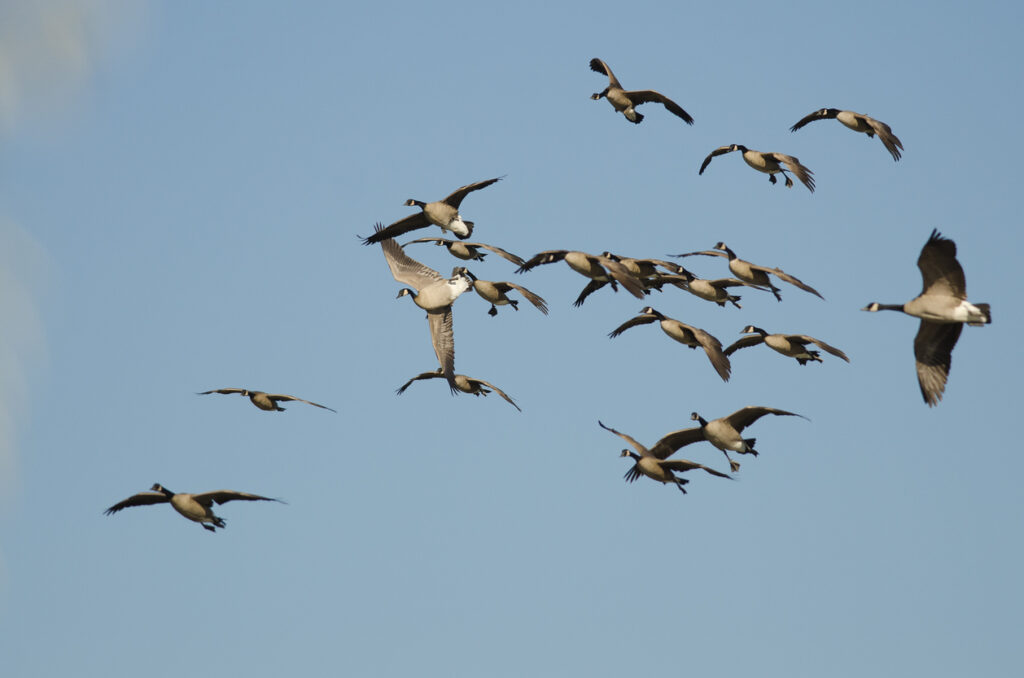 Photo by iStock
Why Do Geese Whiffle?
The most obvious advantage of whiffling is the ability to descend quickly.
Imagine a flock of geese approaching a small lake surrounded by trees. Rather than circling repeatedly or making a long, shallow approach, the birds can remain at a higher altitude until they are relatively close to their destination, then lose height rapidly.
But landing efficiency may not be the only reason geese use this unusual technique.
Whiffling has also been associated with predator avoidance. A goose descending slowly along a predictable flight path could be easier for an aerial predator to intercept. Sudden changes in altitude and direction may make its movements more difficult to anticipate.
The same principle has possible advantages in areas where waterfowl experience hunting pressure, although researchers have not established that avoiding hunters is a primary reason for the behaviour.
Whiffling may also help birds manage challenging wind conditions or make quick adjustments during a crowded landing.
And there’s another intriguing possibility: sometimes, geese might simply be playing.
Bird behaviour specialists have suggested that some whiffling, particularly among younger birds, could be associated with play or practising aerial manoeuvres. However, this interpretation remains speculative.
Whatever the motivation, the technique demonstrates that geese are capable of far more sophisticated aerial movements than their familiar V-shaped formations might suggest.
The Upside-Down Goose
Perhaps the strangest part of whiffling is what happens to the goose’s head.
When a bird rolls its body upside down, its head doesn’t necessarily follow. Instead, the neck twists dramatically, allowing the head to remain relatively level even while the body is inverted.
The result can look downright impossible: a goose flying belly-up with its head still pointing in the normal direction.
Maintaining a stable head position is important for birds in flight. Their vision helps them navigate, assess distances, avoid obstacles and coordinate movements. Keeping the head steady while the body changes orientation may help preserve a useful view of the surroundings.
Scientists have studied the remarkable stabilizing capabilities of geese’s necks, including their ability to compensate for movement of the body. A 2015 study published in the Journal of the Royal Society Interface also examined how birds stabilize their heads during flight, specifically noting the unusual head position maintained by whiffling geese.
It’s an impressive feat of coordination, especially considering how quickly the entire manoeuvre can happen.
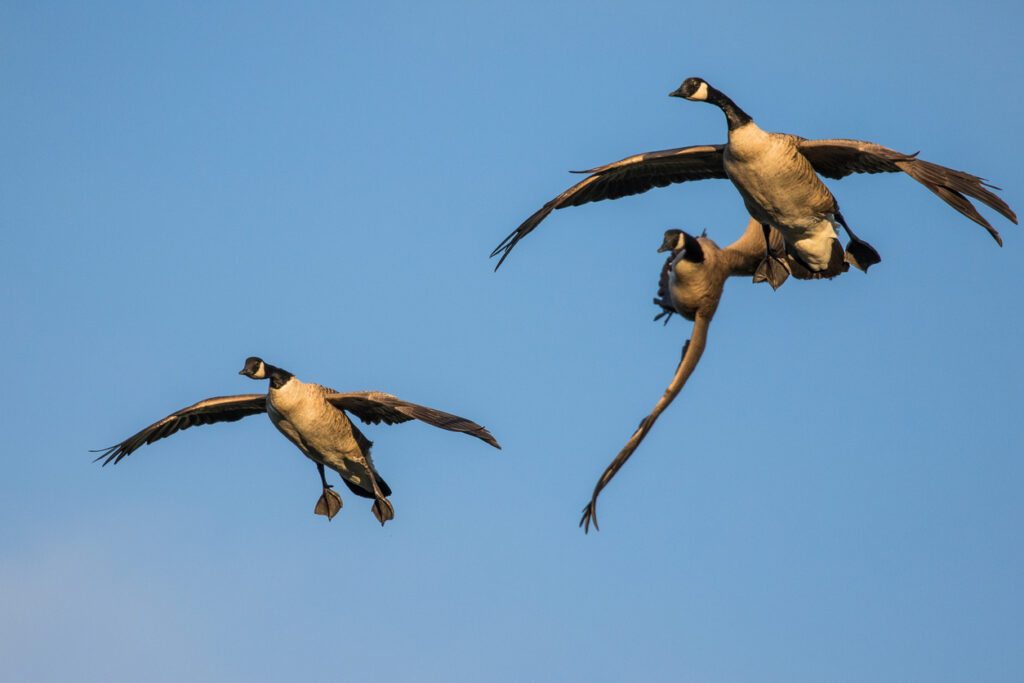 Photo by iStock
Not Just A Canada Goose Trick
Although Canada geese are among the most familiar practitioners of whiffling, they aren’t the only birds capable of it.
Other goose species, ducks and even certain shorebirds have been observed performing similar aerial manoeuvres. BirdNote, a wildlife education program, identifies yellowlegs and godwits among the birds known to whiffle.
For British Columbians, Canada geese provide plenty of opportunities to witness the behaviour firsthand.
The species is widespread across the province, occupying wetlands, agricultural areas, lakes, estuaries and urban parks. Some populations migrate seasonally, while others remain in southern British Columbia throughout the year.
Autumn can be an especially interesting time to watch geese as flocks gather and move between feeding areas and overnight roosts.
A good vantage point near a lake or wetland may reveal far more than the familiar sight of birds flying in formation. Watch closely as a flock approaches the water, particularly when the birds are descending from a considerable height.
A goose that suddenly banks, rocks from side to side or appears to tumble toward the surface may be performing a whiffling manoeuvre.
Not every landing involves whiffling, and not every bird performs a complete inversion. Some movements are subtle, while others are spectacular enough to make an observer wonder whether the bird has lost control.
A Masterclass In Aerial Control
For all their noisy honking, awkward waddling and occasional confrontations on the ground, geese are remarkably capable aviators.
Their wings carry them over long distances, their flock formations help coordinate travel, and their ability to manipulate airflow allows them to execute surprisingly complex manoeuvres.
Whiffling is a particularly striking example of that versatility.
What appears to be a bird falling helplessly from the sky is actually a carefully controlled change in flight. The goose disrupts its normal lift, drops rapidly toward its destination, then restores its flying position before landing.
The next time you see a flock of Canada geese approaching a lake, resist the temptation to look away once they break formation.
The most impressive part of their flight might be just about to begin.