

If you’re a conscientious hunter, you likely pick up your empty shotgun shells after they hit the ground. After all, they are little more than plastic litter after being fired. Maybe you even feel a little guilty about dumping all those empties into the trash after you get home. As an active handloader of rifle and handgun ammunition, I certainly do. This might have caused you to wonder if it’s possible to reload those empty hulls and even save some money in the process.
Advertisement
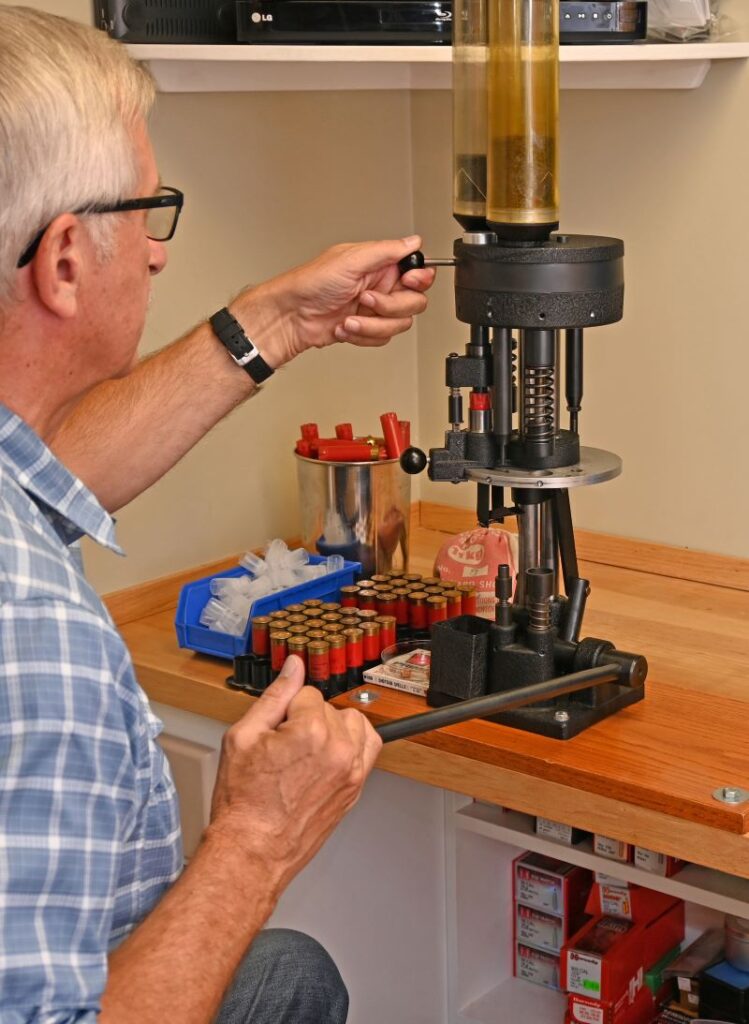 Photo By Al Voth
Reload Shotshells
It’s true that, just like any other centrefire ammunition, shotshells can be reloaded. The reasons for assembling your own shotgun shells aren’t much different than why it’s done for rifle ammunition. It includes producing ammunition which is tailored to a specific gun and the use for that gun/ammunition combination. There’s also an immense amount of satisfaction in using personally assembled ammunition to fulfill shooting goals. This is part of what makes handloading such a fascinating hobby all by itself. And of course, there’s the money-saving aspect as well. However, the dollars saved in reloading shotshells aren’t as significant as those saved when reloading metallic cartridges, especially when reloading 12 gauge. However, for a hunter who uses some of the less popular gauges, such as 16, 20 or even 410 Bore, the savings can be significant. This is why I suggest to anyone wanting to handload shotshells to first calculate the cost and availability of components in their location and compare the per-shell price of handloaded ammunition to that of factory fodder. If economics are your primary motive for handloading, and the numbers make sense for you, then dive in.
Advertisement
Tools
The most expensive tool required for shotshell reloading is the press. These don’t look much like rifle reloading presses – they are self-contained, gauge-specific machines which handle most of the reloading chores, with no extra dies or shell holders required. The cheapest one I know of is the Lee Load-All at $110. The next step up is something like the MEC 600 Jr. at about $330 CAD. Prices go up rapidly from there as production rates increase and the press becomes fully automatic, delivering a loaded round with each pull of the handle.
A scale for measuring powder and shot weights is a requirement to keep shot and powder weights at safe limits. The other requirement is a good manual, such as Lyman’s Shotshell Reloading Handbook, now in its fifth edition. In fact, I recommend the manual should be your first purchase and you should read all of the introductory sections before buying any tools or components.
Advertisement
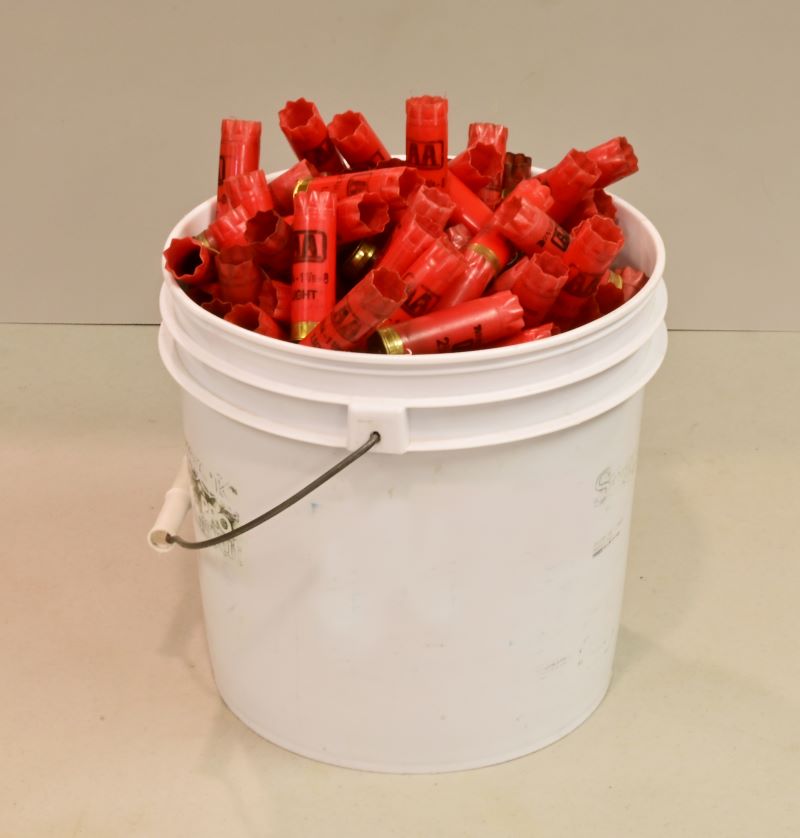 Empty shotgun hulls can be reloaded in a process similar to reloading empty rifle cartridge cases.
Photo By Al Voth
Components
A typical shotgun shell has the same parts as a rifle cartridge (case, primer, powder and projectile) with one exception: shotgun shells also have a wad. And like a rifle cartridge, the case is recycled while all the other components are replaced. However, that empty case is extremely important, and a significant effort is required to examine it and determine it’s suitable for reloading.
Briefly, there are two types of shotgun hulls: plastic cases with a one-piece body and basewad, called compression formed or unibody cases, are the best for reloading. Cases with separate basewads, called polyformed cases, are less suitable because the basewad deteriorates quickly or can even become detached. Shining a light into an empty case or sacrificing one by cutting it open will quickly reveal which type a case is. If it’s the same colour and material as the case body, it’s a unibody type. If it’s a different material or colour than the body, it’s a polyformed case. Depending on the load and its pressure, unibody cases can be loaded eight to 10 times before becoming unusable. Polyformed cases should never be loaded more than three times, as that separate basewad can become loose and cause problems, including remaining stuck in the barrel after a shot.
Primers are the first part of a shotshell to be replaced, and all gauges use the same primer, called a 209 shotshell primer. When purchased as a component, there will be several different brands available and, just like rifle primers, they should not be interchanged. Swapping primer brands can easily raise or lower pressures by 3,000 psi.
Of course, those primers ignite the powder in the shotshell and that’s the next component to consider. Fortunately, the selection of powders available for shotshell reloading has never been greater. Unfortunately, powders are in short supply these days, so don’t expect to have your pick of the litter. Which powder is suitable for any given load depends on numerous factors, with a good handloading manual typically capable of providing several options which will work fine, whether the load be a high-velocity steel shot hunting load or a light target load.
Wads are next and the options here are also numerous. This is because a different wad is required as shot charges vary from heavy to light, and as powder volume changes as well. In addition to protecting the shot in its journey down the barrel, part of the wad’s purpose is to completely fill the shotgun hull so that all components are packed tightly together.
Shot, of course, varies by size and type (lead, steel, bismuth, etc.), which means the weight also varies. This affects powder type and quantity, as well as wad selection, making for a tricky balancing act to get everything just right. Buffer material can be added to the shot in handloaded shells as well. Just be sure to follow the manufacturer’s directions and add it into the shot charge weight when consulting the manual.
Assembly
The best way to ensure the assembled shotshell is safe and effective is that previously mentioned manual. A good shotshell reloading manual will have a complete listing of safe load recipes.
This listing typically begins by first identifying the gauge and shell length being reloaded, then determining the brand and type of hull to be refilled. The weight of the shot charge comes next and then we get to a table which offers primer, powder and wad options for a prudent and efficient load. Changing any component or factor from that listed in the manual is unwise.
The reloading process will vary somewhat depending on the type of press being used, but the basic steps are the same, with the first step always being the removal of the old primer. The case head then needs to be resized back to its original dimensions, a task which the press should accomplish easily. Note that some cheaper presses don’t perform this task and a separate base resizing tool may be required, especially if the shells will be used in a semi-auto or pump shotgun. The insertion of a new primer is next, followed by the correct amount and type of propellant powder. The wad follows, but it’s not just a matter of inserting the wad. It needs to be pressed in place with some significant pressure, usually about 20 to 40 pounds of force. The shot is the last component placed into the case, but it’s not the last operation performed. Crimping the shell mouth closed is the last step and a critical one.
Plastic shotshells are typically closed up with a crimp that has either six or eight segments. When using once-fired hulls, it’s important that the crimp tool on the press match the crimp which was originally placed on the shell at the factory. Often, you’ll find heavy hunting loads have a six-segment crimp, while lighter target loads have an eight-segment crimp. Like wad seating, setting the crimp needs to be done with some force as this is what’s holding all the components in place and providing the resistance which allows the powder to burn effectively and reach its correct working pressure.
A good crimp should look much like the original factory one and not have any holes through which shot can leak out. Some shooters who use steel shot in wet environments will take the extra step of putting some waterproofing material over the crimp to prevent moisture from making its way into the shell and rusting the shot.
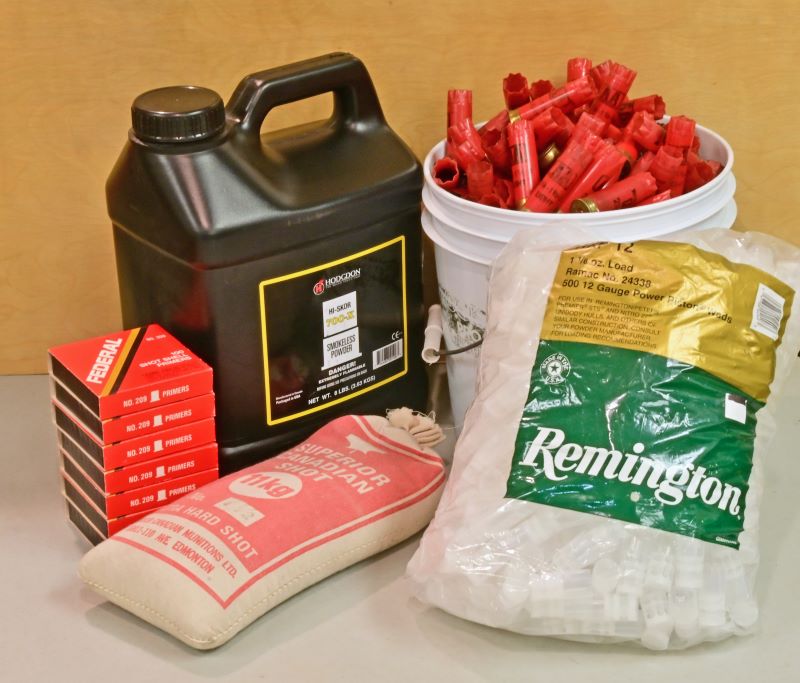 Shotshells are comprised of five components, with only the hull being reused.
Photo By Al Voth
Testing
With some freshly loaded shotshells in hand, it’s a good idea to test them to see if they are meeting your needs. Taking a few shots at a patterning board will quickly reveal if the pattern is what you expected. If not, some load changes may be needed or just a change of choke tubes. Chronographing is also a valuable exercise, as it’ll reveal whether or not the shells are providing the velocities required. And then there’s reliability. Shells which jam an autoloader or a pump gun are too much of a frustration to deal with in the field, so it’s better to learn of problems on a shooting range than far from home in the middle of a hunt.
Yes, reloading shotshells can be done, and while it’s not for everyone, it can be a fun activity that saves some serious money, especially for the smaller, less popular gauges.
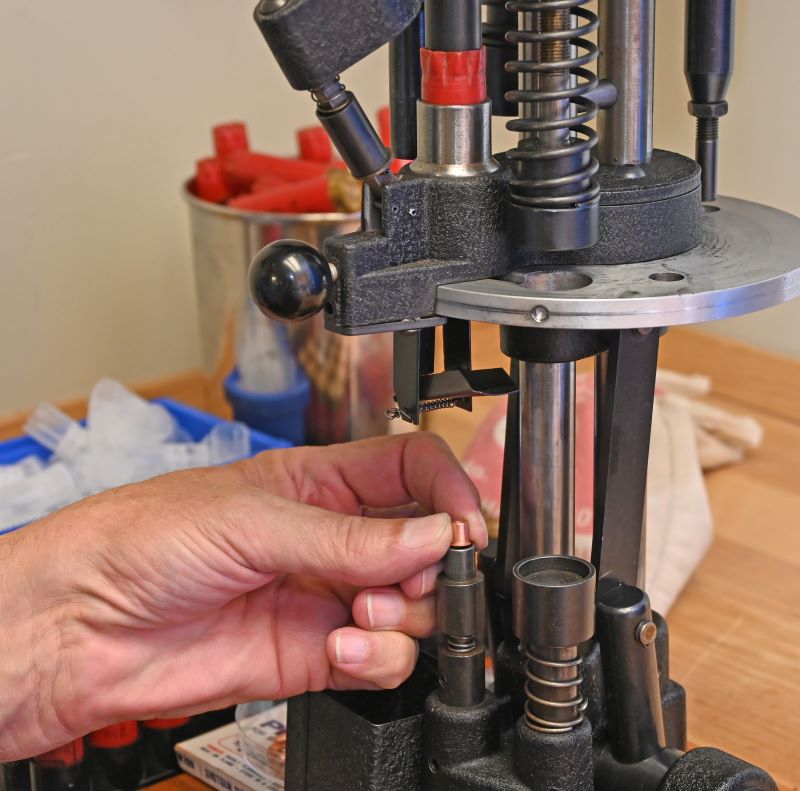 Shotshell reloading presses, like this Ponsness Warren 375, are self-contained units which perform all the necessary reloading functions.
Photo By Al Voth