

A fallen tree in a river might look like a mess. Its exposed roots catch branches, its trunk interrupts the current and debris gradually accumulates around it. To an observer, it can appear to be little more than an obstruction waiting to be swept away by the next flood.
Advertisement
To a salmon, however, that jumble of wood can mean shelter from predators, relief from a strong current and access to deeper, cooler water.
Advertisement
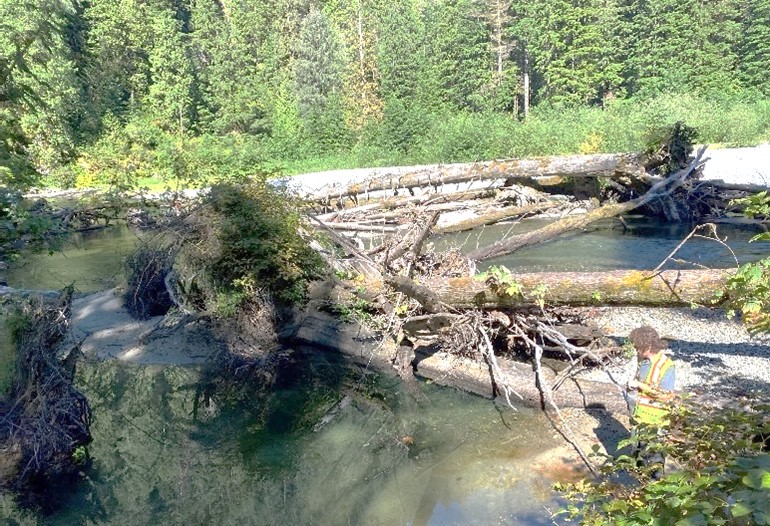 Photo By Department of Fisheries And Oceans
Across British Columbia, restoration specialists are taking advantage of these natural benefits by deliberately building structures known as engineered log jams. Constructed from large logs, whole trees, root systems and sometimes boulders, these carefully designed structures mimic the complex wood accumulations that once occurred naturally throughout many of the province’s waterways.
Advertisement
It may seem counterintuitive to place large obstacles into a river, particularly one already struggling with flooding, drought or erosion. Yet research increasingly shows that the relationship between wood, flowing water and sediment is essential to healthy salmon habitat.
And in rivers where decades of logging, development and channel modification have removed that complexity, putting the wood back may help the waterway begin repairing itself.
A Missing Ingredient In Healthy Rivers
For much of the 20th century, fallen trees were routinely cleared from streams and rivers throughout the Pacific Northwest. Large accumulations were considered barriers to navigation, irrigation and flood control, while removing them was sometimes believed to improve fish passage.
According to Fisheries and Oceans Canada (DFO), widespread stream-clearing activities between the 1940s and 1970s contributed to the loss of large woody debris from waterways that had historically contained abundant fallen trees.
Over time, the ecological consequences became increasingly apparent.
Without logs and root systems to interrupt the current, some rivers became wider, shallower and more uniform. Pools that once offered shelter during low water disappeared, while gravel and sediment moved through channels differently. In some locations, streams became disconnected from the floodplains and side channels that provide important seasonal habitat for young salmon.
In a naturally functioning river, large pieces of wood help shape the channel. A fallen tree can redirect the current, causing water to scour a deeper pool on one side while depositing gravel on the other. Branches and roots slow water near the banks, creating quieter areas where juvenile fish can rest and feed.
As more debris accumulates, the structure may become larger and more stable. Sediment collects, vegetation takes root and new channels can develop around it.
Far from being an obstacle to river health, a log jam can help create the conditions that support an entire aquatic ecosystem.
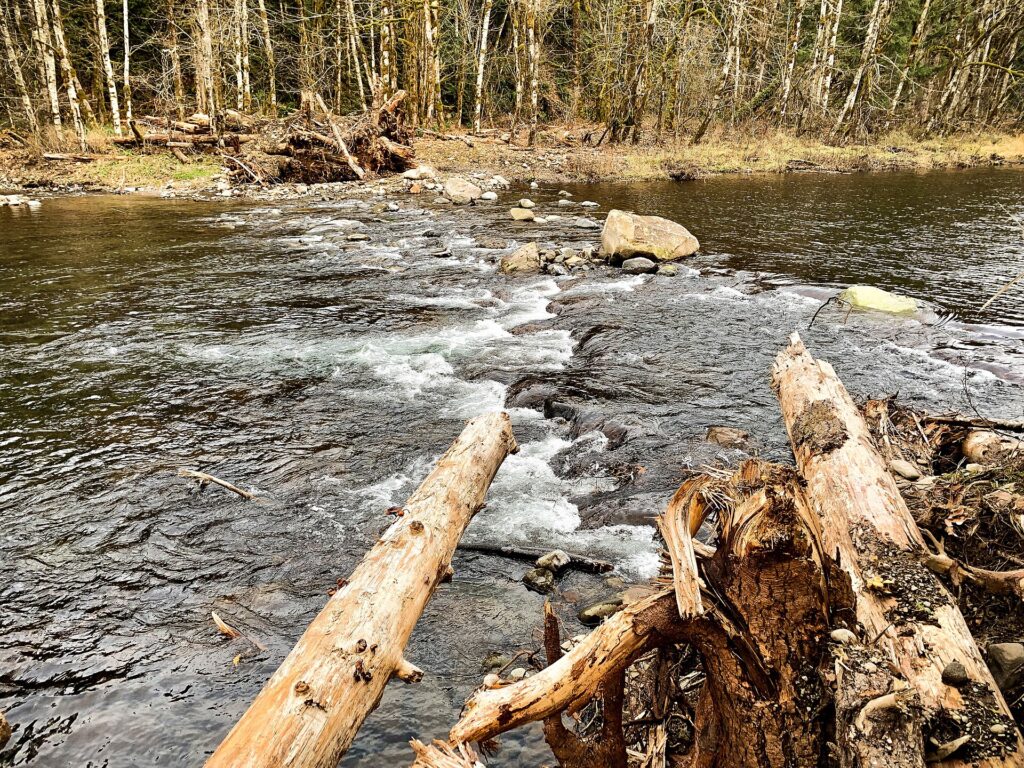 Large logs and woody debris form part of a habitat restoration project on Oregon’s Salmon River. The work at Wildwood Recreation Site includes the creation of a side channel intended to improve habitat for coho and Chinook salmon, as well as steelhead.
Photo: Greg Shine/Bureau of Land Management
Engineering A Natural Solution
Modern engineered log jams, often called ELJs, are designed to reproduce those processes in waterways where natural wood recruitment is limited or where existing habitat has been damaged.
Their construction involves considerably more planning than simply dropping trees into a stream.
Restoration teams begin by studying the river’s behaviour, including its flow patterns, channel shape, sediment movement, flood history and existing fish habitat. They identify locations where introducing wood could help create deeper pools, protect important habitat or reconnect the river with adjacent floodplain areas.
Engineers must also consider the forces that act on a structure during high water. A log jam that remains stable in summer could experience enormous pressure during spring runoff or an atmospheric river event.
Depending on the site, construction may involve embedding logs into the riverbank or streambed, interlocking whole trees with their root systems intact, or using boulders and other anchoring methods to provide additional stability.
Some newer designs use self-ballasting structures, in which the weight and arrangement of the wood help hold the log jam in place without relying on cables or other conventional anchoring materials.
The objective isn’t necessarily to stop or slow the entire river. Instead, the structures redistribute water, creating a combination of faster currents, sheltered eddies and deeper pools. They also influence how gravel and sediment move through the channel.
That complexity is particularly important for salmon because different species, and different stages of their lives, require different conditions.
Young coho, for example, often benefit from slow-moving areas with abundant cover, especially during winter floods. Chinook salmon may use deeper pools and sheltered habitats while rearing or migrating. Spawning adults also depend on suitable gravel, water depth and flow conditions.
By changing how water moves through a section of river, engineered log jams can help create several habitat types within a relatively small area.
Restoring Rivers Across BC
One of the province’s newest engineered log jam projects is underway on the Nicola River near Merritt, where salmon habitat was severely affected by the devastating floods of November 2021.
The flooding followed a summer of intense heat, drought and wildfires, creating particularly difficult conditions for fish already facing environmental pressures. High water reshaped sections of the river, moving enormous quantities of gravel and sediment, widening channels and filling pools.
For salmon returning during hot, dry conditions, the loss of deep-water refuge can be especially serious.
Led by the Scw’exmx Tribal Council in collaboration with local First Nations and provincial and federal partners, restoration efforts on the Nicola include installing large woody structures designed to recreate some of the habitat lost during flooding.
DFO documented earlier work in the Nicola watershed in 2024, describing how large woody structures could provide cover, attract aquatic insects and encourage the formation of deeper pools.
In July 2026, two additional engineered log jams were installed on Nooaitch Indian Band lands northwest of Merritt as part of a larger salmon recovery initiative. The structures are intended to improve habitat for Chinook, coho and steelhead, while monitoring will help determine how the river and its fish populations respond.
The Nicola project is particularly significant because engineered log jams of this type are being introduced to an Interior river system, where seasonal flow conditions can differ considerably from those along the coast.
On Vancouver Island’s west coast, another ambitious restoration effort is taking place in the Tranquil Creek watershed, known as hiłsyaqƛis, within Tla-o-qui-aht First Nation territory near Tofino.
Historical logging and road construction dramatically altered parts of the watershed. The removal of large trees reduced the natural supply of wood entering the creek, while unstable slopes and sediment movement contributed to deteriorating fish habitat.
Redd Fish Restoration Society and the Tla-o-qui-aht First Nation have been working to reverse those changes through a combination of forest restoration, slope stabilization and engineered log jam construction.
Among the measures undertaken is the construction of 16 self-ballasting engineered log jams across a four-hectare gravel bar. Other structures are designed to encourage the development of pools while providing additional shade and cover for salmon.
Rather than relying exclusively on artificial reinforcement, the self-ballasting approach uses interlocking, heavy timber to recreate some of the stability that would naturally be provided by large fallen trees.
The work is intended to restore physical river processes while the surrounding forest gradually recovers. Eventually, as streamside trees mature, they may provide a renewed supply of large wood, allowing the river to sustain more of its own habitat complexity.
It’s an example of an increasingly important principle in aquatic restoration: rather than continually maintaining individual habitat features, encourage the natural processes that create them.
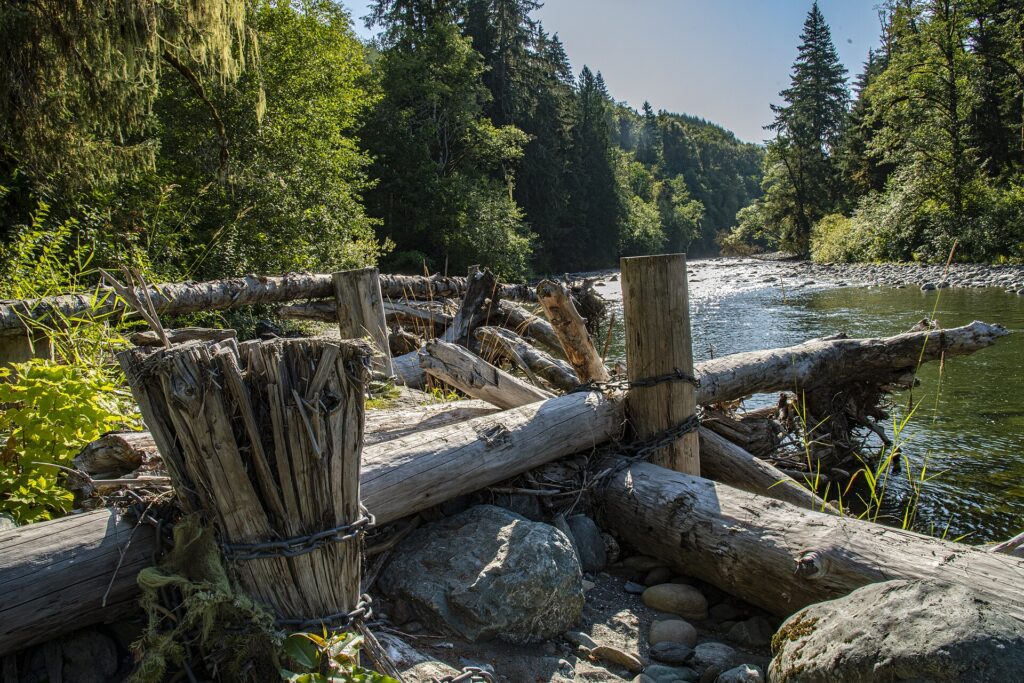 Engineered Log Jam installed in South Fork Nooksack River near Skookum Creek fish hatchery in Washington, on Aug. 7, 2019.
U.S. Department of Agriculture (USDA) Natural Resources Conservation Service (NRCS) in Washington State works with Tribes and other salmon recovery partners to restore salmon habitat in the South Fork Nooksack River (Whatcom County, WA). USDA Photo by Lance Cheung.
Creating Refuges In A Changing Climate
The importance of engineered log jams extends beyond replacing habitat lost to historical logging.
As British Columbia experiences more frequent periods of extreme heat, drought and intense precipitation, restoring the natural complexity of rivers is increasingly being explored as a way to improve their resilience.
Deep pools can provide valuable refuge when summer water levels drop. Where cooler groundwater enters a channel, or where deeper water remains cooler than surrounding shallow areas, those pools may offer fish relief from potentially dangerous temperatures.
The distinction is important: a deep pool is not automatically a cold-water refuge. Its effectiveness depends on factors such as groundwater exchange, shading, water movement and the duration of hot weather.
Nevertheless, by encouraging the formation of pools and increasing interactions between rivers, sediments and floodplains, engineered log jams can help create conditions favourable to temperature-sensitive fish.
The structures can also influence what happens during high water.
Wood accumulations redirect flows and can encourage water to spread into side channels and floodplain areas where sufficient space is available. Those connections provide important habitats for juvenile fish and can moderate some local effects of changing river flows.
When water recedes, protected channels and pools may continue to provide habitat that would otherwise be unavailable.
This approach is increasingly relevant in watersheds affected by atmospheric rivers, where powerful floods can reshape channels in a matter of hours.
However, engineered log jams are not a universal solution to flooding. Their effects depend on channel geometry, local conditions and the surrounding landscape. Poorly positioned structures can increase bank erosion or redirect water toward infrastructure, making careful site selection and engineering essential.
What Does The Research Show?
While the physical benefits of large woody debris are well established, scientists are still investigating how reliably engineered log jams translate into measurable improvements for salmon populations.
Research from Western Washington University has examined long-term monitoring information from 26 engineered log jam restoration sites in Washington State, with particular attention to the creation of deeper pools and the responses of juvenile salmon.
The work reflects an important distinction in habitat restoration: constructing a feature that appears suitable for fish is not necessarily the same as demonstrating that it increases fish survival or production.
A pool may become deeper, for example, but researchers still need to determine whether salmon use it, how long they remain there and whether the resulting habitat contributes to improved survival.
Other research has demonstrated both the potential of wood restoration and the difficulty of measuring its benefits.
A study published in 2025 examining food-web dynamics in river and floodplain habitats found that production of benthic invertebrates and juvenile salmonids increased following engineered log jam restoration in a treated side channel. However, natural changes in untreated habitats were sometimes even greater.
The findings highlight the complexity of river ecosystems, where seasonal conditions, food availability and natural habitat variation can influence fish populations independently of restoration efforts.
More recent geomorphological research on the Little River, a tributary of Washington’s Elwha River, documented substantial physical changes following wood restoration. The researchers found increases in pool frequency, wood abundance and side-channel connectivity, demonstrating how engineered structures can influence channel development beyond their immediate locations.
Together, these studies suggest that engineered log jams can be effective at restoring important physical habitat characteristics, although their contribution to salmon population recovery must be assessed over longer periods.
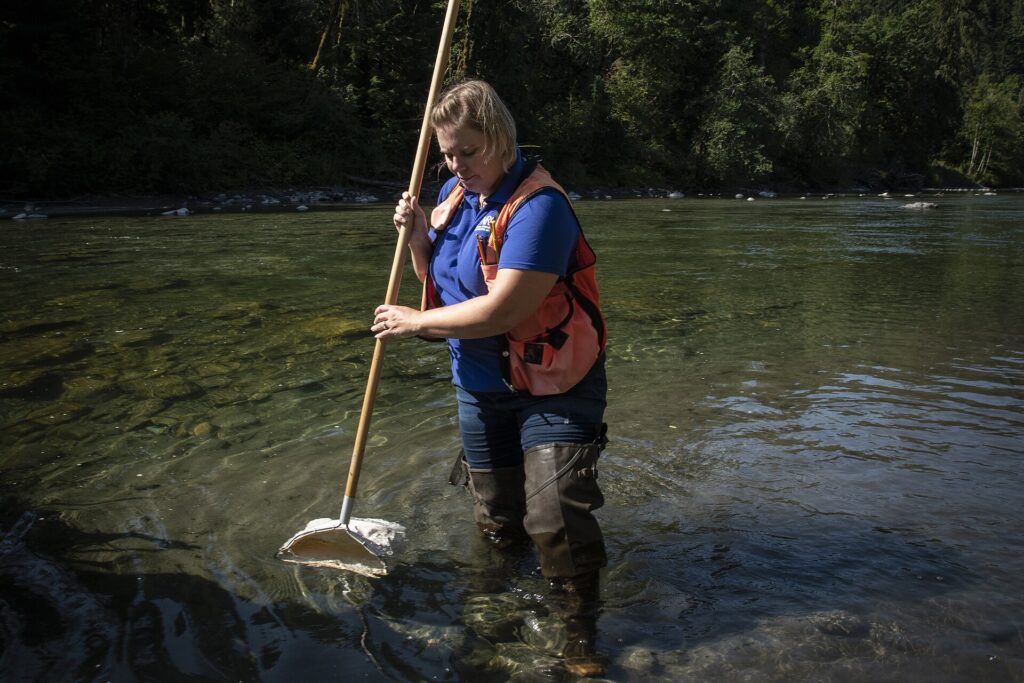 U.S. Department of Agriculture (USDA) Natural Resources Conservation Service (NRCS) Biologist Rachel Maggi uses a D-net to sample aquatic insects as measure of habitat recovery near an engineered log jam structure in the Nooksack River, Washington, on August 7, 2019.
USDA Photo by Lance Cheung.
Measuring Success Beneath The Surface
One of the most important developments in modern river restoration is the increased emphasis on monitoring what happens after construction crews leave.
Researchers can use aerial imagery, drone surveys and detailed topographic mapping to document changes in river channels. Repeated measurements help identify newly formed pools, gravel deposits, bank erosion and changes in connections between the main channel and surrounding floodplain.
Hydrologists can study water velocity and depth, while temperature sensors track conditions through periods of summer heat and low water.
Biologists also assess whether fish are taking advantage of the restored areas.
Depending on the project, monitoring can include underwater observations, fish sampling and electronic tagging methods that allow researchers to study habitat use and movement.
The results can help determine whether structures are performing as intended, whether adjustments are necessary and which designs are most suitable for particular river conditions.
A successful project might produce deeper pools within its first year, but longer-term evaluations are needed to establish whether those pools persist through floods and whether they support more fish.
That’s especially important as climate change alters the conditions under which restoration projects are designed to function.
A structure built to withstand historical peak flows may encounter very different conditions over its lifetime, making adaptability and long-term monitoring increasingly valuable.
Working With The River, Not Against It
Engineered log jams are one component of a much larger effort to restore salmon-bearing waterways.
They cannot replace adequate streamflow, remove barriers to migration or reverse every effect of watershed development. Nor can they compensate for continued habitat degradation upstream.
Their greatest potential often comes when they are combined with other restoration measures, including replanting streamside vegetation, stabilizing eroding slopes, reconnecting side channels and protecting the forests that supply natural wood to rivers.
This broader approach recognizes that healthy salmon habitat isn’t simply a collection of pools and gravel beds. It’s a constantly changing system shaped by water, sediment, vegetation and the surrounding landscape.
Interestingly, the ultimate measure of a well-designed engineered log jam may be how little human intervention it requires in the future.
As natural wood accumulates around the structure, gravel shifts and streamside vegetation grows, the engineered feature can become part of the river’s evolving landscape.
In time, it may become difficult to distinguish from a naturally formed log jam.
And that’s precisely the point.
For decades, the prevailing approach to river management often involved removing obstacles and attempting to control the movement of water. Today’s restoration efforts increasingly recognize that some of those obstacles were essential to the river’s health.
By putting trees back into the water, conservationists are not necessarily creating something new. They’re helping restore a relationship between forests, rivers and salmon that existed long before people began modifying the landscape.
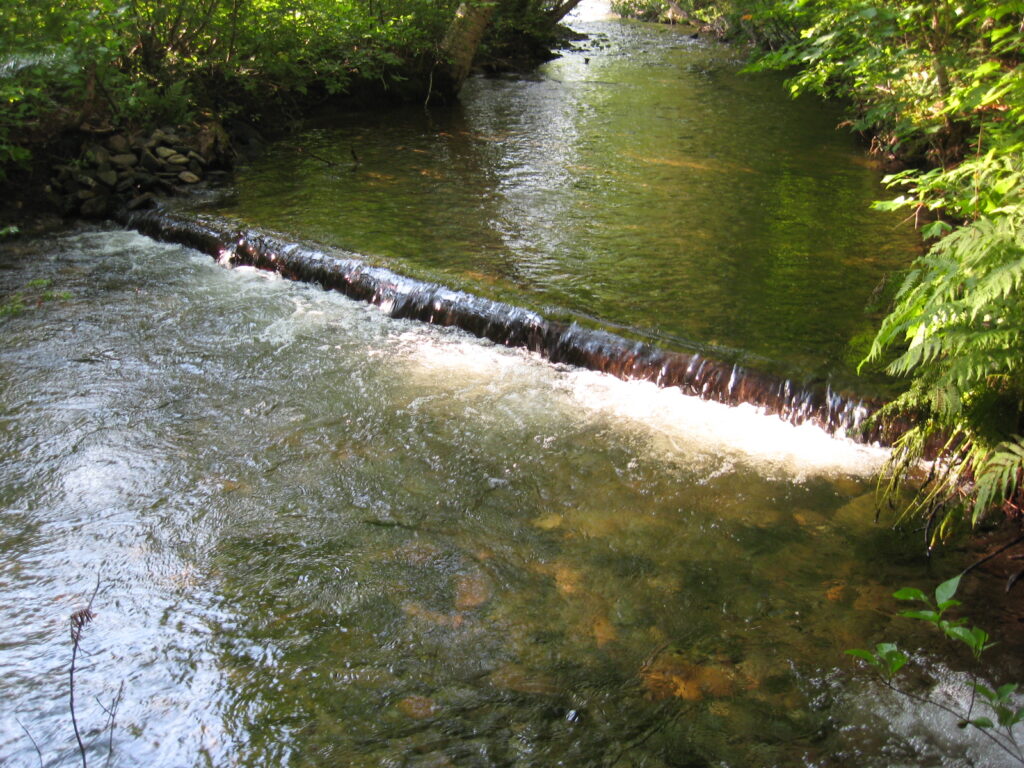 A digger log structure installed by the Margaree Salmon Association demonstrates another approach to restoring fish habitat. Positioned across a stream, the log alters water flow and encourages the formation of a deeper pool downstream.
Photo: Margaree Salmon Association