

New restrictions on water-based recreation are now in effect at Mount Robson Park as BC moves to prevent the spread of whirling disease into the Fraser River watershed.
Advertisement
As of Monday, May 4, 2026, the use of all watercraft and wading gear is prohibited in the park’s lakes, rivers and creeks. The ban applies to both motorized and non-motorized vessels, including canoes, kayaks and paddleboards, as well as waders and boots typically used for fishing.
Advertisement
Visitors can still swim or fish from shore using clean gear.
Advertisement
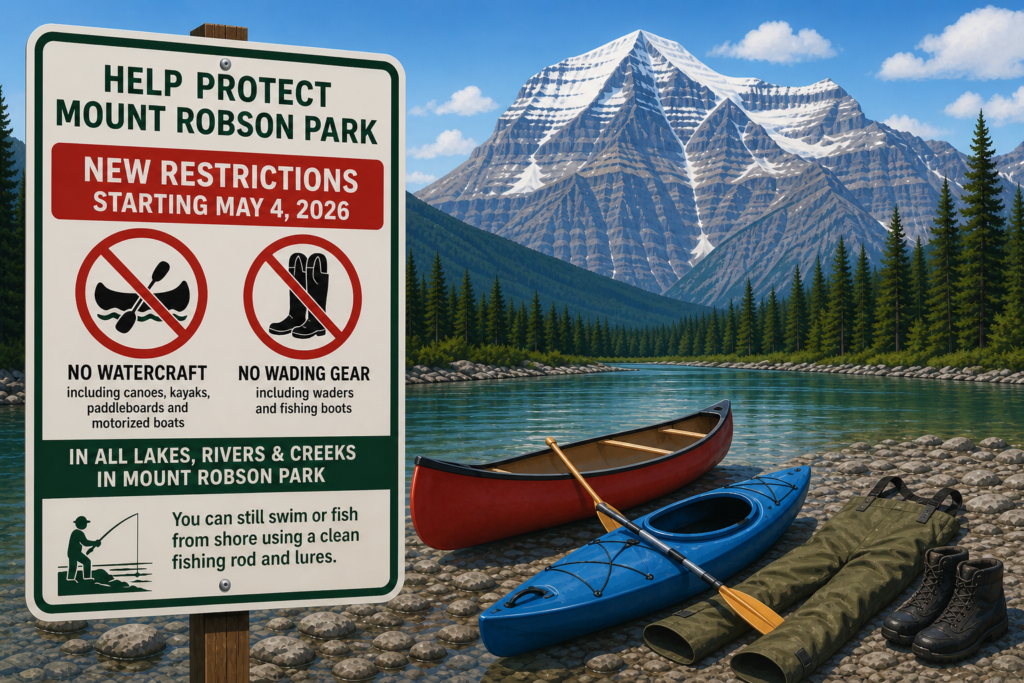 Illustration by OpenAI
Preventing The Spread Of A Damaging Fish Disease
Whirling disease is an infectious finfish disease caused by a microscopic parasite that attacks the head and the spinal and nervous tissue of fish. The disease damages the brain stem and spinal cord, resulting in an erratic “whirling” swimming pattern in infected fish.
It spreads through the movement of fish, mud and water, with spores capable of attaching to recreational equipment, infected fish (alive or dead), fish parts and even pets. Juvenile trout, salmon and whitefish are particularly vulnerable, and infections can result in significant mortality. The disease poses no risk to humans or pets.
There is currently no treatment for whirling disease, making prevention the only effective response. Officials continue to emphasize the “Clean, Drain, Dry” protocol for gear and watercraft, along with compliance with BC’s Pull the Plug law, which requires drain plugs to be removed during transport.
Proactive Move Despite No Confirmed Cases
The disease has not been detected in Mount Robson Park, but provincial and federal agencies are taking a precautionary approach.
Whirling disease was first confirmed in Canada in August 2016 in Banff National Park and has since been identified in four major watersheds across southern and central Alberta, as well as Yoho National Park and Kootenay Lake.
BC continues to monitor priority waterbodies in the Columbia River watershed in partnership with First Nations and federal agencies. The Mount Robson restrictions align with similar measures in Banff and Jasper national parks, as well as existing restrictions in Yoho, Kootenay and Waterton national parks and Mount Assiniboine Provincial Park.
Protecting A Critical Watershed
Mount Robson Park plays a key role in safeguarding the headwaters of the Fraser River—one of North America’s most important salmon-bearing systems – and attracts tens of thousands of visitors annually.
Officials warn that if whirling disease were introduced in the park, it could move downstream through the Fraser River watershed, potentially affecting native salmon populations, ecosystems and fisheries across the province.
With no cure available, park visitors are being urged to follow restrictions and best practices to help protect BC’s fisheries and aquatic ecosystems.