

Tracking thousands of unique salmon populations – and the factors affecting their survival – across BC and the Yukon is an extraordinary challenge. Today, innovative technology like artificial intelligence (AI), tracking chips and drones is helping close the gaps. In the face of growing climate threats and budget constraints, these tools are helping expand monitoring capacity and gather the data needed to drive salmon conservation.
Advertisement
“By combining new technology with strong partnerships, we are better equipped to monitor salmon and their habitats, and to understand where and when we may need to intervene to support their conservation. With thoughtful and strategic use, emerging tools can also strengthen local stewardship and uphold Indigenous sovereignty,” says Dr. Katrina Connors, senior director, Pacific Salmon Foundation (PSF.)
Below are 6 innovative ways PSF and our partners are using tech to bolster salmon and habitat monitoring.
Advertisement
 Photo by iStock
-
Counting How Many Salmon Come Home With AI
PSF, along with Simon Fraser University, the Wild Salmon Center and Lumax Inc., is partnering with First Nations groups to pilot AI-powered salmon counting systems at 12 monitoring sites across BC and Alaska.
These systems combine video and sonar cameras with computer-vision models that automatically detect and identify salmon as they migrate upstream to their spawning grounds. Since 2020, field crews have collected hundreds of thousands of hours of footage, and thanks to the use of AI, managers can now assess salmon returns in near real-time.
Advertisement
For the Kitasoo Xai’xais First Nations in BC’s central coast, this approach pairs well with fishing weirs – Indigenous in-river fences used to sustainably harvest salmon – to enable monitoring in remote locations.
“The Kitasoo Xai’xais are a nation of 350 to 400 people in a very large area. We simply couldn’t get this scale of information on important indicator stocks without the AI tool,” says Christina Service, a biologist with Kitasoo Xai’xais Stewardship Authority.
-
Mapping Where Young Fish Go
Scientists have long wondered why so many juvenile salmon don’t survive their first winter at sea. To address this mystery, researchers are using Passive Integrated Transponder (PIT) tags – chips like those used in credit cards – to track salmon movements across their lifecycle.
To identify bottlenecks to salmon survival, PSF and the BC Conservation Foundation have tagged more than 450,000 juvenile Chinook, coho, and steelhead since 2020. Antenna arrays in 11 rivers across Vancouver Island log the tagged fish as they migrate to sea and when they return to spawn, with nearly 3,000 adult fish detected in 2025.
A new database now enables partners and the public to explore results by river, species, and age class. These insights are helping identify critical survival bottlenecks and ultimately direct conservation efforts where and when salmon need the most help.
 Photo by iStock
-
A Chip To Reveal Salmon Stressors
How do salmon respond to different environmental pressures, and why? Fish don’t show stress the way humans do, but their genes can tell the story.
Using small, non-lethal gill biopsies, the ‘Fit-Chip’ enables researchers to see which salmon genes are activated in response to challenges like disease or temperature extremes. Developed by Dr. Kristi Miller at Fisheries and Oceans Canada (DFO) with support from PSF, the technology functions like a rapid health check for fish. When applied at a broader scale, it can reveal patterns linking salmon survival to specific stressors — and guide efforts to mitigate threats to salmon.
On the west coast of Vancouver Island, PSF is working with partners to pair PIT tags and Fit-Chip technology in a bid to better understand what’s happening to threatened Chinook populations.
“By uncovering the challenges young Chinook salmon face and the ultimate fate of those same fish, we’ll gather evidence more directly than ever before about what’s impacting survival,” says Dr. Andrew Bateman, the project lead at PSF.
-
Tracking Predators From The Air
To assess how predators are affecting salmon, First Nations partners, PSF, and the BC Conservation Foundation are leading coordinated efforts to monitor seals and sea lions in key salmon-bearing rivers on Vancouver Island.
Crews are using drone surveys, camera traps, and underwater detection and mapping technology to help track these predators as well as their movements and feeding behaviour over time. The team is also developing artificial intelligence models to streamline image review and produce consistent predator counts by location.
The goal of this research is to develop a long-term monitoring framework that supports Indigenous-led stewardship and informs evidence-based decisions on seal and sea lion management.
-
Getting More Reliable Catch Data
Traditional harvest monitoring efforts can be costly and labour-intensive. How can we gather more catch data to drive evidence-based decision-making?
On commercial vessels, cameras can now be used to record fishing activity and upload footage for review, with AI helping identify the species, timing, and location of catches. This supports real-time analysis of fishing pressure and bycatch.
In recreational fisheries, PSF has worked with BC Conservation Foundation, Vancouver Island marinas and DFO to turn fish-cleaning tables into valuable sources of data. When anglers clean their catch, overhead motion-activated cameras allow researchers to identify the species caught and hatchery fish with clipped adipose fins – all while preserving the anonymity of the angler. Integrated receivers in the tables can also detect PIT tags in the fish.
These tools help paint a picture of where and when salmon are caught, strengthening fisheries data without increasing the burden on fishers or field staff. PSF is now looking to expand this work with AI to help decode video footage and integrate data into management decisions more efficiently.
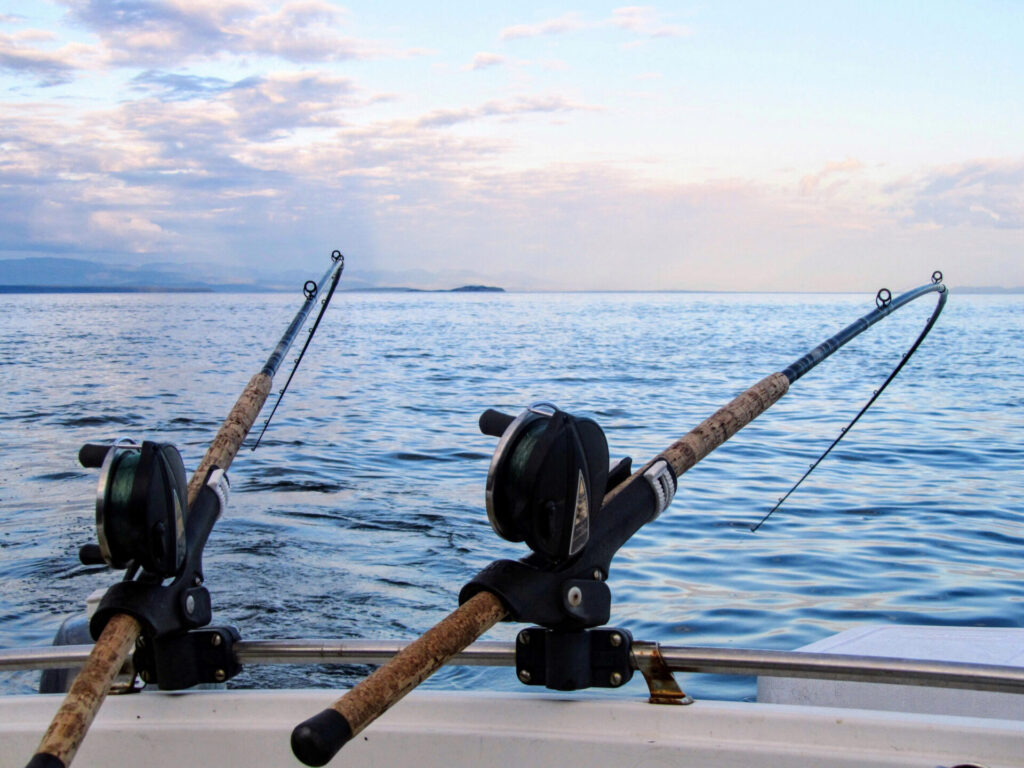 Photo by iStock
-
Finding Salmon Cool Spots During Heat Waves
During extreme drought, some rivers across BC now exceed 20°C, a dangerous threshold for cold-water fish. Thankfully, groundwater can enter rivers and create pockets of cooler water, known as thermal refuges, which allow salmon to rest and recover from temperature extremes.
“It’s similar to air conditioning. When it’s hot out, people move inside to thermoregulate. Salmon do the same thing,” says Auston Chhor, a salmon habitat biologist with Raincoast Conservation Foundation.
PSF has collaborated with Dr. Eric Saczuk from BCIT’s Remotely Piloted Aircraft Systems Hub to train 10 Indigenous partners in the use of thermal drones to monitor and map salmon habitat.
In 2025, the Scw’exmx Tribal Council, Citxw Nlaka’pamux Assembly, and Raincoast Conservation Foundation partnered to identify key thermal refuges in the Coldwater River and test ways to enhance and expand these cold-water sites to support salmon.
Salmon Tech At A Crossroads
Recent research indicates the past decade was the worst on record for salmon monitoring in BC and the Yukon. Yet innovative tools have already demonstrated their value in monitoring salmon and their habitats alongside existing methods and partnerships. As climate pressures intensify, sustained monitoring and high-quality data remain essential to inform conservation priorities and management decisions.
“At a time when monitoring budgets are under increasing pressure, leveraging the efficiencies provided by technology is key to supporting salmon conservation and driving effective salmon recovery,” says Connors.
PSF thanks the BC Salmon Restoration and Innovation Fund (BCSRIF), a joint investment by the Government of Canada and by the Province of British Columbia, for their support.