

Long before “trapping” was a word used in provincial regulations, the taking of furbearers was woven into the seasonal economies, technologies and trade networks of Indigenous peoples across what is now British Columbia. Coastal and interior Nations harvested animals for food, tools and clothing, and traded pelts among communities. When European demand for fur surged, those existing systems were pulled into a global marketplace – one that reshaped economies, travel routes, settlement patterns and relationships on the land in lasting ways.
Advertisement
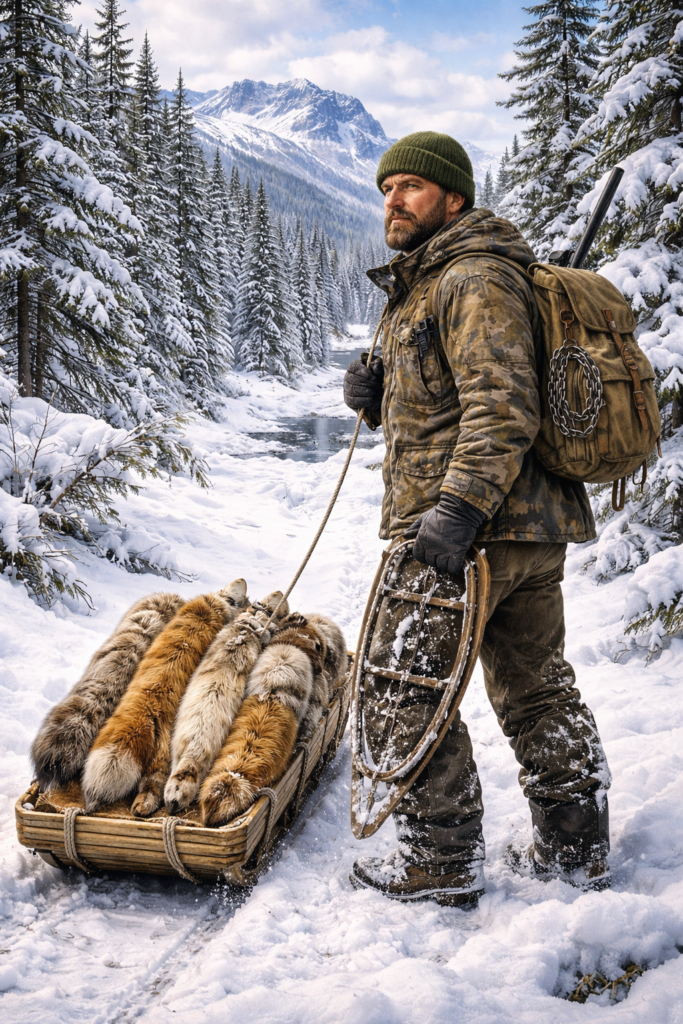 Illustration by OpenAI
The Fur Trade Era: An Economy Built On Pelts – And Partnerships
The early fur trade in northwestern North America depended on Indigenous expertise. Trading companies relied on local knowledge of animal behaviour, winter travel and harvesting methods. In the historical record, the balance of power shifted over time – especially as European goods became more embedded in daily life and as disease and colonial policies destabilized communities – but the trade’s foundation remained the work of Indigenous trappers and traders.
As competition intensified, the region became part of a larger corporate contest led by firms like the Hudson’s Bay Company and the North West Company. The “fur trade economy” wasn’t just barter at a post; it was an organizing force that drove the creation of interior forts, transportation systems and new labour networks. Even the accounting systems reflected fur’s central role – beaver pelts were widely used as a unit of value in company records, illustrating how completely the trade structured daily commerce.
Advertisement
By the 19th century, the trade’s logistics stretched across mountain corridors and river highways. Permanent posts and “brigade” transport systems linked remote trapping areas to supply routes – an early industrial-scale movement network built around furs.
Advertisement
From Frontier Practice To Formal Management
As British Columbia entered the 20th century, trapping increasingly shifted from an open-ended frontier livelihood to a regulated activity. Today, the province describes trapping as the active management of 17 furbearing species under provincial legislation and standards, tying the practice directly to wildlife management rather than simply fur production.
A key feature of that modern approach is the registered trapline system, which is still described in provincial regulations as the primary framework for setting harvest guidelines and managing furbearing animals. In plain terms: trapping is not simply “wherever you can go.” Traplines are geographically defined and registered, and harvest guidance is connected to seasons, pelt primeness, vulnerability of age/sex classes, abundance and capture technology.
The legal scaffolding matters. The province’s Wildlife Act, RSBC 1996, c 488 includes provisions governing registered traplines and compliance requirements. That legal framework – combined with synopses and ongoing updates – helps define what “licensed” and “lawful” trapping looks like in British Columbia today.
The Ethics Pivot: Humane Standards & Trap Certification
If there’s one area where modern trapping most visibly diverges from popular stereotypes, it’s the shift toward formalized humane standards and mandatory equipment requirements.
British Columbia’s current trapping standards are explicitly tied to the Agreement on International Humane Trapping Standards (AIHTS), which Canada ratified in 1999. The province notes that AIHTS sets performance minimums for killing and restraining traps used for listed species, and that British Columbia began requiring certified traps for a subset of AIHTS species in the 2007–2008 season. The government frames the ongoing implementation as part of maintaining access to international fur markets while improving trapping methods.
Outside government, organizations focused on furbearer management also emphasize “best management practices” (BMPs) – a research-driven approach that evaluates traps and systems for welfare outcomes, efficiency, selectivity and practicality. While BMPs are often discussed in broader North American contexts, the core idea mirrors the policy direction British Columbia highlights: reducing suffering, improving selectivity and modernizing tools.
 Illustration by OpenAI
Trapping Today: Fewer Trappers, Bigger Questions
Modern trapping in British Columbia exists inside a set of competing public expectations:
Wildlife management and local stewardship.
Supporters argue that regulated trapping can contribute to furbearer management and provide on-the-ground observations in remote areas – an informal monitoring presence that can be especially relevant when budgets and capacity are strained. The province’s own language places trappers in an “active management” role, which aligns trapping with conservation objectives rather than only commerce.
Rural livelihoods and cultural continuity.
For some families, trapping remains part of a seasonal mixed economy – alongside guiding, forestry, wage work or subsistence harvesting. For others, it’s also about skills transfer: winter travel, backcountry safety and knowledge of animal sign. Groups such as the BC Trappers Association – formed in 1945 and describing itself as the oldest trapper’s association in Canada – position trapping as a “renewable heritage” and emphasize conservation and education.
Social licence and animal welfare.
Public acceptance is not guaranteed. Trapping is one of the most emotionally charged wildlife topics in Canada, often shaped by viral imagery and deep disagreements about whether any killing for fur can be ethical. This is where standards like AIHTS and certified traps become central – not as a cure-all, but as a measurable response to welfare concerns and bycatch risk.
Changing governance expectations.
In 2026, the province has also been running public engagement on proposed hunting and trapping regulation updates for the 2026–2028 seasons – an example of how management is continuously revisited through consultation and policy review rather than locked in place for decades.
Why This History Still Matters In 2026
Understanding trapping’s history in British Columbia matters because it explains the friction points – and the misunderstandings – around the practice today.
The early fur trade was not simply an adventurous chapter of canoe brigades and frontier posts. It was a system that altered Indigenous economies and introduced lasting disruptions alongside new trade opportunities. That legacy complicates modern conversations about “tradition,” because tradition here includes both deep Indigenous harvesting histories and the realities of colonial commerce.
At the same time, the contemporary trapline system, compulsory reporting, seasons and trap certification requirements show that modern trapping is not an unregulated relic. It is a managed activity governed by law, updated synopses and internationally connected standards that, at minimum, aim to reduce suffering and improve accountability.
In practical terms, the relevance of trapping in British Columbia today rests on a narrow but significant question: can it maintain public trust while meeting measurable wildlife-management and welfare expectations? For trappers, that means operating transparently inside the registered trapline system and using certified equipment. For critics, it means pushing for stronger standards, better enforcement and, often, fundamental change. For everyone else, it means recognizing that the debate is not only about fur coats and prices, but about how British Columbia chooses to manage wildlife on vast landscapes where human presence is seasonal, dispersed and deeply contested.