

A mountain goat standing calmly on a narrow ledge can make the laws of gravity seem optional. While powerful legs and an exceptional sense of balance contribute to its climbing ability, much of the secret lies at ground level.
Advertisement
Each of the animal’s hooves functions like a piece of built-in climbing equipment, combining a firm edge, a flexible gripping surface and independently moving toes.
Advertisement
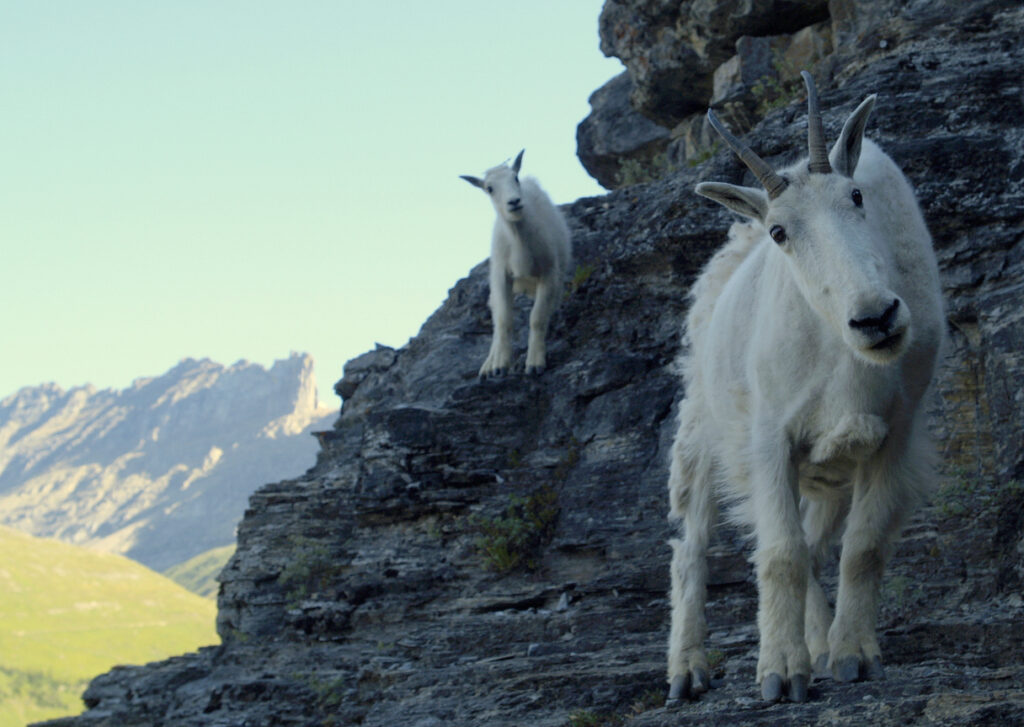 Photo by iStock
A Natural Climbing Shoe
A mountain goat’s hoof is cloven, meaning it is divided into two toes. Surrounding each toe is a hard keratin sheath that can catch on small ledges and find purchase in narrow cracks.
Advertisement
Inside that rigid outer edge is a softer, textured pad. Slightly flexible and almost rubber-like, the pad conforms to uneven rock and creates friction over a larger surface area. Working together, the hard rim and soft centre provide both edging ability and grip – much like the stiff edge and sticky rubber sole of a human climbing shoe.
The BC government notes that these rough traction pads project slightly beyond the rim of the hoof, helping mountain goats travel over rocky and slippery ground. The two toes can also spread apart to distribute the animal’s weight or close around a rocky projection for extra traction while descending.
Dewclaws positioned higher on the foot provide another safeguard. On steep or loose ground, they can make contact with the surface and help prevent the animal from slipping.
More Than Specialized Feet
The hooves are only one part of the mountain goat’s climbing system. These stocky animals also have powerful shoulders and forelimbs that help pull the body upward.
In a 2016 biomechanical study, researchers examined footage of a mountain goat ascending a 45-degree slope in the Canadian Rockies. During the initial push, the animal extended its hind leg while keeping its foreleg close to its body. It then used movements in the front leg to raise its centre of mass farther up the slope.
In other words, the goat was not simply scrambling forward. Its limbs worked through a controlled sequence of pushing, bracing and lifting – while its hooves maintained contact with the rock.
Cliffs Offer Protection
This climbing ability allows mountain goats to occupy terrain that many predators cannot easily follow. Cliffs, rock ledges and talus slopes serve as “escape terrain,” offering security from animals such as wolves, cougars and bears.
Mountain goats often remain close to this protective terrain even while feeding. BC habitat models describe steep, rugged slopes as an essential part of suitable goat habitat, with feeding areas generally located near cliffs or other escape terrain.
Steep slopes can also improve access to food during winter. Snow is more likely to slide or blow away from exposed ridges and rock faces, uncovering grasses, sedges, shrubs, lichens and other vegetation.
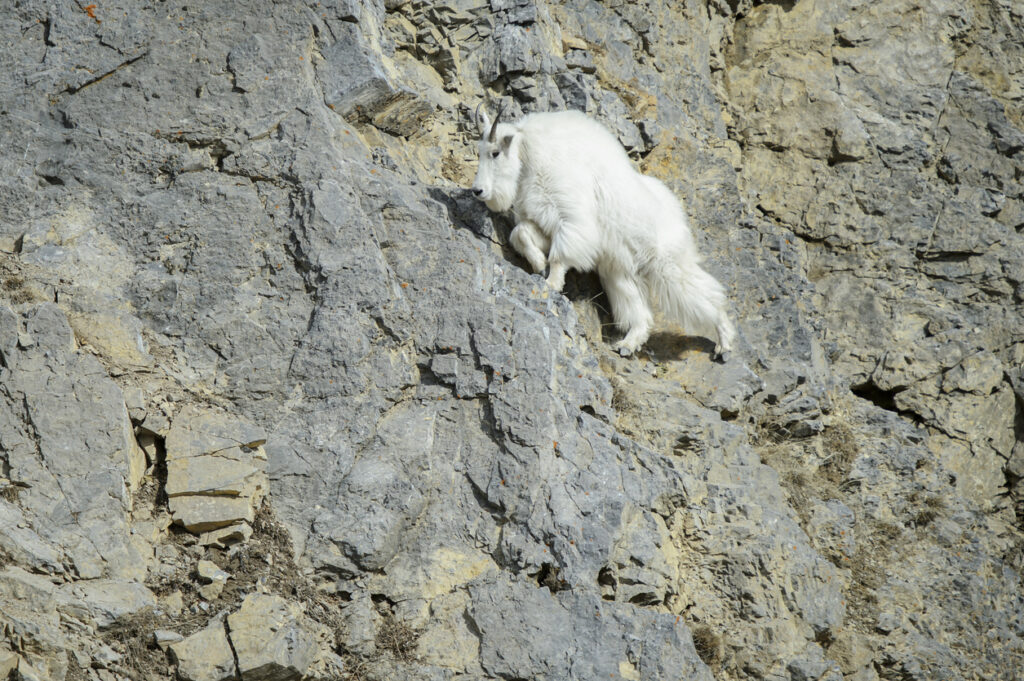 Photo by iStock
At Home In BC’s Mountains
Mountain goats occur throughout most of BC’s mountain ranges, although they are absent from Vancouver Island, Haida Gwaii and most other coastal islands. Despite their name and appearance, they are not true goats of the genus Capra. They belong to a group of hoofed mammals sometimes known as goat-antelopes and are related to animals such as chamois and gorals.
Wherever they are found, their relationship with steep terrain is unmistakable. What appears to us as an intimidating wall of broken rock can provide a mountain goat with food, shelter and a reliable route away from danger.
Anyone fortunate enough to see one should enjoy the encounter from well back. Parks Canada recommends remaining at least 100 metres away and avoiding any action that causes the animal to move. Mountain goats are particularly sensitive to disturbance during winter, when conserving energy is critical.
From a distance, however, it is worth taking a closer look at where the animal places its feet. Every careful step reveals an adaptation millions of years in the making: a climbing shoe the goat never has to take off.