

Picture a moose standing along the edge of a quiet northern lake. At first, it appears to be doing what moose do best: wading through the shallows, perhaps stopping to nibble on a few aquatic plants. Then, without warning, the enormous animal lowers its head, pushes farther into the water and disappears beneath the surface.
Advertisement
For an animal that can weigh more than 600 kilograms and stand over two metres tall at the shoulder, it is an impressive sight. Yet swimming, diving and underwater foraging are perfectly natural behaviours for moose. In fact, these seemingly awkward giants are among the most capable swimmers in the deer family.
Advertisement
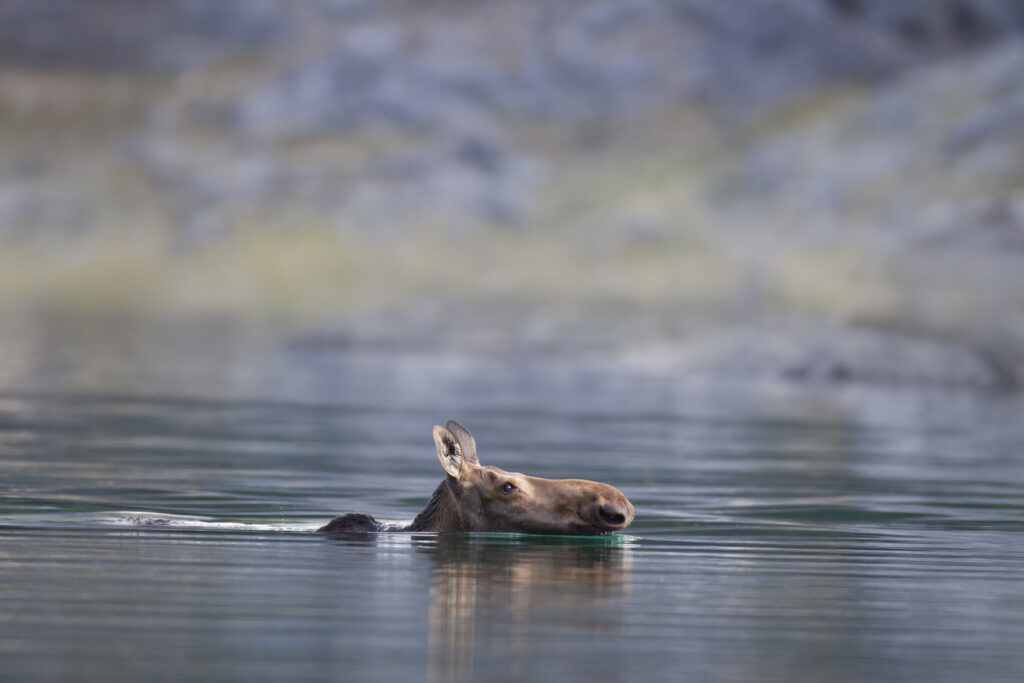 Photo by iStock
And their aquatic abilities extend well beyond the lakes, rivers and wetlands of British Columbia. Moose have been documented swimming considerable distances through open saltwater, travelling between islands and mainland habitats.
Advertisement
So, how does an animal better known for wandering through forests become such an extraordinary swimmer?
Built For The Water
Despite their considerable size, moose possess several physical adaptations that make swimming surprisingly easy.
Their long, powerful legs provide propulsion, while their large bodies and thick coats help them remain buoyant. Individual hairs in a moose’s coat have air-filled interiors, providing both insulation and additional flotation.
Their swimming technique resembles an exaggerated dog paddle, with all four legs moving beneath the surface. Their powerful front legs do much of the work, while their head and elongated muzzle remain above water.
According to the Alaska Department of Fish and Game, moose can swim at speeds approaching 10 kilometres per hour and maintain that pace for up to two hours. Scientific literature has also documented swimming distances of approximately 12 to 20 kilometres, demonstrating just how much ground – or water – these animals can cover.
These abilities serve several purposes. Moose regularly cross rivers and lakes to reach feeding areas, move between seasonal habitats and escape potential predators. Their swimming ability also allows them to access places that would otherwise be inaccessible.
Diving For Dinner
Perhaps even more remarkable than their swimming endurance is the moose’s ability to forage underwater.
Although moose spend much of their time browsing on terrestrial vegetation such as willow, birch and aspen, aquatic plants become an important food source during the warmer months.
Moose consume pondweed, water lilies, bur-reed, horsetails and other vegetation growing in wetlands and along lake bottoms. Some plants can be reached by wading into shallow water and lowering their heads beneath the surface. Others require considerably more effort.
When feeding in deeper water, moose can completely submerge their bodies to reach vegetation growing along the bottom. Observations have documented dives exceeding 5.5 metres, or approximately 18 feet, with moose remaining underwater for 30 seconds or longer.
Rather than searching for fish or other aquatic animals, these underwater excursions are entirely herbivorous. Moose use their flexible lips and mouths to grasp vegetation, pulling it free before returning to the surface to chew.
But why go to such lengths for a mouthful of plants?
One important reason is sodium.
After spending winter feeding largely on woody twigs and branches, moose can benefit from replenishing depleted mineral reserves. Many aquatic plants contain substantially more sodium than their terrestrial counterparts, along with valuable protein and other nutrients.
This is particularly important for lactating cows, which face increased nutritional demands while nursing calves. Aquatic vegetation can also be relatively easy to digest, making it a valuable seasonal food source.
Not all moose have access to aquatic feeding areas, however. Those living in habitats without suitable wetlands can obtain necessary nutrients from terrestrial plants and mineral sources.
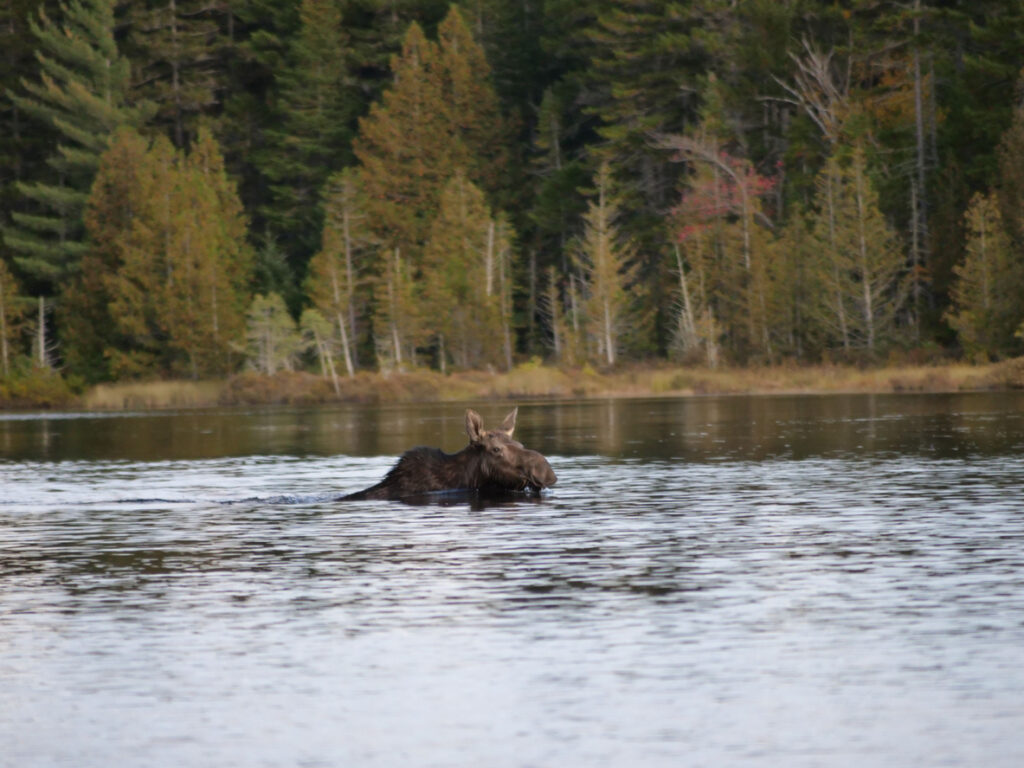 Photo by iStock
A Nose Designed For Diving
One of the moose’s most recognizable features also plays an important role beneath the water.
That enormous, drooping muzzle is more than an unusual facial characteristic. Unlike most members of the deer family, moose possess specialized muscles and cartilage that allow them to constrict and close their nostrils. This helps prevent water from entering their nasal passages while their heads are submerged.
Researchers examining moose nasal anatomy have identified an unusually complex arrangement of tissues that supports this ability. A 2019 study published in The Anatomical Record explored these adaptations and their potential significance in understanding how certain mammals evolved to exploit aquatic environments.
The research highlighted how unusual moose are among hoofed mammals, not only because they willingly enter deep water, but because they actively forage beneath its surface.
In other words, the moose’s famously oversized nose is an important piece of specialized equipment.
Moose In The Ocean? Even In BC
As impressive as their freshwater abilities are, moose can also navigate saltwater – and British Columbia has an interesting connection to this unusual behaviour.
A 2005 study published in the scientific journal Diversity and Distributions revealed that moose had expanded their range into the coastal temperate rainforests of British Columbia, including at least three islands.
Researchers from the University of Victoria and the Raincoast Conservation Society documented evidence of moose throughout portions of the coastal mainland and on offshore islands. Indigenous traditional ecological knowledge suggested that moose began colonizing these coastal environments during the mid-1900s, around the same period that logging opened up major watersheds crossing the Coast Mountains.
Although the study did not document individual ocean crossings, the presence of moose on coastal islands raises an intriguing possibility: these powerful swimmers may have crossed saltwater channels to reach new habitat.
There is additional evidence just north of the BC border. According to the Alaska Department of Fish and Game, moose that migrated from British Columbia through the Stikine and Unuk river valleys have established populations in southeastern Alaska. Wildlife officials report that moose can apparently swim across the roughly 10-kilometre-wide Clarence Strait to reach Prince of Wales Island.
Such journeys are not without risks. Strong currents, waves, cold water and exhaustion can turn an ocean crossing into a dangerous undertaking. Nevertheless, the ability to swim across saltwater channels can allow moose to disperse into new territories, reach feeding grounds and potentially escape competition or predators.
While most British Columbians associate moose with inland forests, lakes and wetlands, these remarkable animals have demonstrated that even coastal waterways need not be an insurmountable barrier.
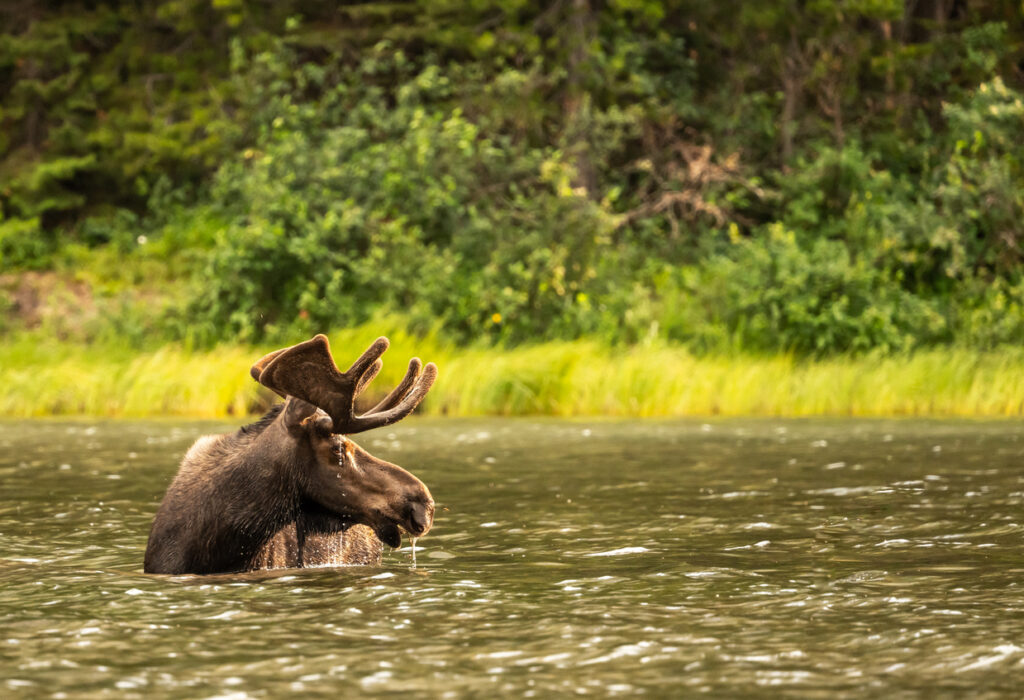 Photo by iStock
More Than Just A Way To Travel
Swimming offers another important benefit: relief from summer heat.
Moose are exceptionally well adapted to cold climates, but their large bodies and insulating coats make them susceptible to overheating during warmer weather.
Spending time in lakes, ponds and wetlands allows them to cool down without expending as much energy. Water also provides some relief from biting flies and other insects that can make summer miserable.
In British Columbia, summer sightings of moose standing chest-deep in wetlands or feeding along lake margins are therefore not uncommon.
For anyone fortunate enough to encounter a swimming moose, however, keeping a respectful distance is essential.
In June 2020, a cow moose attempting to cross Okanagan Lake near Peachland was reportedly frightened by spectators gathering along the shoreline. Rather than coming ashore, she turned around and swam back across the lake, potentially exhausting herself in the process. Conservation officials subsequently reminded the public to give wildlife sufficient space and a clear escape route.
Whether encountered from a canoe, along a lakeshore or beside a quiet wetland, a moose should always be allowed to continue its journey undisturbed.
Moose may be famous for their towering antlers, enormous size and impressive ability to navigate deep snow, but their relationship with water is every bit as fascinating.
From diving to lake bottoms for mineral-rich plants to swimming kilometres through open ocean, these remarkable animals are far more versatile than their lumbering appearance suggests.
The next time you spot a moose standing at the edge of a lake, don’t be surprised if it decides to go for a swim. It might be heading for dinner – or embarking on a surprisingly long journey.