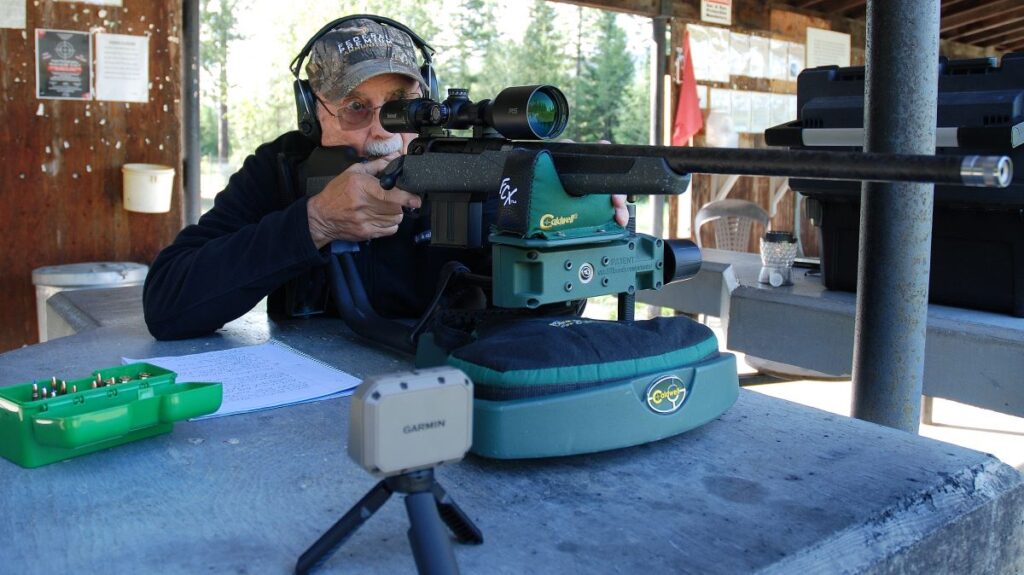
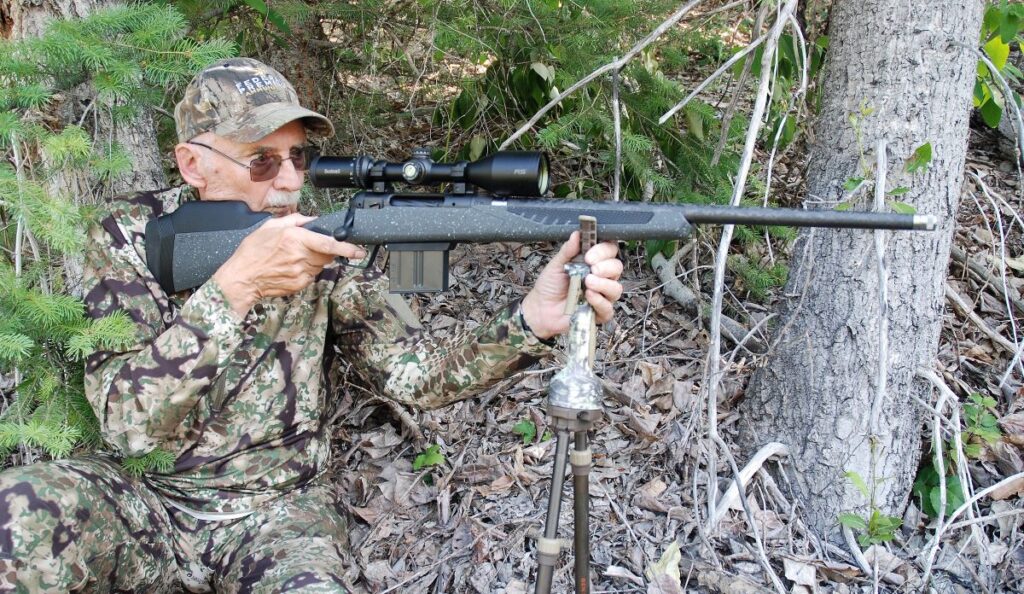
With the big game hunting season now in your rearview mirror, predator hunting is a great way to spend the winter months. It will not only keep your hunting and shooting skills alive, but you can also make a few bucks in the process. I purchased my first dedicated predator rifle in the early 1970s, a Remington Model 700 heavy barrel, chambered in a 22-250 Remington. This rifle was a tack driver that, with the right ammunition, was devastating on coyotes with minimal pelt damage. Regrettably, the rifle, with its wood stock and heavy contoured barrel, was no lightweight. By the time I added a varmint scope, it was a tank to carry. At the time, accuracy trumped weight. Today, with the advent of carbon fibre-wrapped barrels, that is no longer the case.
Advertisement
Savage 110 Carbon Predator 22-250 Remington
The 110 has been around since 1958. It quickly developed a reputation for affordable accuracy, which sustained its production through the years. It is said to be one of the longest-running rifle designs in history. The Carbon Predator is one of their latest 110 variants, boasting a Proof Research carbon fibre-wrapped stainless steel cut rifled barrel – a collaboration that aims to deliver the accuracy of a heavy steel barrel but at a reduced weight.
Advertisement
Moving on to other features, it sports a fluted two-lug bolt, matte black carbon steel receiver, two-piece Weaver-style bases, two sling swivel studs, ACIS detachable box 10-round magazine, threaded muzzle and an AccuTrigger that is adjustable between 1.5 and four pounds. This 20-year-old Savage trigger innovation has stood the test of time and performance. Another notable innovation is Savage’s AccuFit stock that offers a custom type of fit. Pick from the various comb heights and spacers for the perfect eye-to-scope alignment and length of pull.
Last, rather that securing the action to the stock with screws alone, Savage uses a rigid aluminum chassis that is permanently embedded in the stock for the entire length of the action and forend.
Advertisement
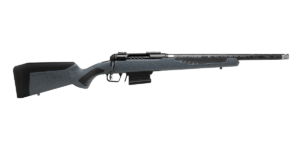 Photo By Savage
Rifle Specifications
Calibre: 22-250 Remington
Total length: 42.25 inches
Barrel length: 22 inches
Weight: Seven pounds, six ounces
Trigger: Adjustable from 1.5 to four pounds
Twist rate: 1/12 inches
Length of pull: Adjustable from 12.75 to 13.75 inches
Drop at comb: Adjustable
Magazine capacity: 10 rounds
Bushnell R5 6-18×50 Scope
Bearing in mind that the kill zone on a coyote is not much bigger than a softball, the objective was to find a lightweight scope that could deliver precise, long-range shots. The R5 is a feature-packed, value-priced scope. I will list a number of these features, utilizing Bushnell’s technojargon with a very brief function.
- HDOS: HD optical system for maximum light transmission, resolution and contrast
- Fully Multi-Coated Optics: Maximum light transmission
- Glass Etched Reticle: The reticle is etched directly into glass for precision
- EXO: Lens coating that repels water, oil, dust and debris
- Waterproof Construction: IPX7 waterproof and fog-proof
- Side Parallax: Easy focus for all ranges without adding length to the scope
- Illuminated DOA LRH800 Reticle: Drop points out to 800 yards with a floating centre dot and five to 10 mile-an-hour wind holds
The scope also comes with an unconditional lifetime warranty “No Matter What”, and a free ballistic app.
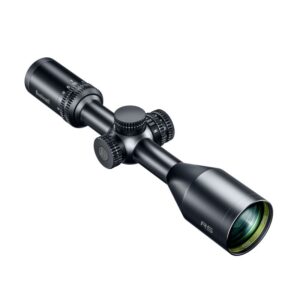 Photo By Bushnell
Scope Specifications
Magnification: 6-18x
Objective lens: 50 millimetres
Length: 12.6 inches
Weight: 22.1 ounces
Tube size: 1 inch
Eye relief: 3.9 inches
Elevation and windage adjustment: 60 MOA
FOV at 100 yards: 18 feet at 6x, six feet at 18x
Test Results
Testing this rifle was not without incident. First up, when unpacking the rifle, I immediately noted that the rear baffle on the bolt had dislodged during transport. While I was able to reinstall it, it was a bit tricky, so I reached out to Savage and they provided the following website for reinstallation: https://savagearms.com/blog/post/how-to-install-the-rear-baffle-on-a-savage-model-110.
I then moved on to mounting the scope, where I encountered problem number two. The rifle’s Weaver-style bases afforded only limited mounting options. Even when reversing the bases to shorten the mounting length, it was a snug fit that offered no adjustment for eye relief or optimum sight picture. A rail would have eliminated this problem. Or, alternately, a scope with a longer barrel may have negated the problem.
Problem number three: On the range, I discovered a head space issue that necessitated the rifle being returned to Savage Canada for repair. They corrected the issue immediately.
While the foregoing issues are correctable, my fourth and final niggly is not, at least as far as I understand it. Its 10-round magazine is overkill for a predator rifle this side of the border. Not to mention that when fully loaded, it added 15 ounces of weight to the rifle. The magazine itself was tricky to load, as well as being noisy/rattily and made carrying the rifle uncomfortable. Originally, I had assumed that Savage would have offered a smaller magazine – but not so, nor could I find an aftermarket option.
Moving on to the positives. On my postal scale, the rifle weighed seven pounds, eight ounces and nine pounds, two ounces with the scope and mounts. This equated to three pounds less that my predator rifle of yesteryear. The AccuTrigger was nothing short of perfect. It broke constantly at two pounds, 14 ounces, with no variation in pull weight, nor could I detect any creep or overtravel. I also really liked the versatility of the AccuFit stock. It provides various comb height options for a perfect scope/sight alignment, as well as length of pull options to accommodate most all individual requisites. Meanwhile, one of the primary reasons I decided to test this rifle was its Proof Research carbon fibre-wrapped barrel – a barrel that should offer the type of accuracy I was seeking in a predator rifle, but at significantly less weight than a heavy steel barrel.
The scope proved to be an ideal match for this rifle, offering plenty of magnification options. Its optical clarity and brightness also provided clear images for the kind of precision shots required on predator hunts.
When organizing the ammunition for this test and bearing in mind that the twist rate for this rifle was rather slow, a 1/12, I stayed away from any of the 60-plus grain weighs for fear of stabilization issues that could be associated with these heavier bullets. I kept all my handloaded bullets to 55 grains or less.
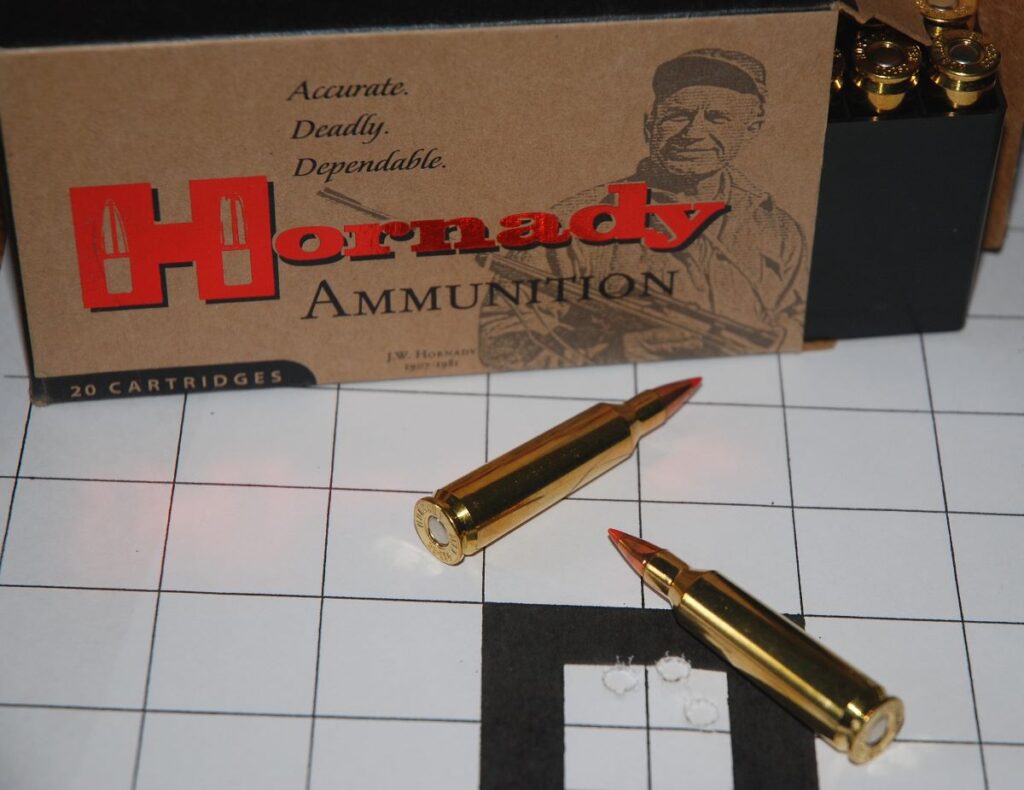 Hornady Varmint Express 40-grain V Max ammunition proved the best factory accuracy with this .505-inch group
Factory Ammunition
| Brand | Bullet | Velocity (fps) | Group Size (inches) |
| Hornady Varmint Express | 55-grain V Max | 3,437 | .680 |
| Hornady Varmint Express | 50-grain V Max | 3,647 | .818 |
| Hornady Varmint Express | 40-grain V Max | 3,948 | .505 |
| Federal Premium | 55-grain Sierra GameKing | 3,549 | .555 |
| Federal Premium | 55-grain Nosler Ballistic Tip | 3,465 | .860 |
| Federal Premium | 43-grain Speer TNT Green | 3,840 | .798 |
| Winchester Ballistic Silvertip | 50-grain Silvertip | 3,737 | .795 |
| Winchester Varmint X | 55-grain Polymer Tip Rapid Expansion | 3,612 | .725 |
| Sako Gamehead | 55-grain Soft Point | 3,543 | 1.230 |
| Barnes VOR-TX | 50-grain TSX FB | 3,569 | .660 |
| Remington AccuTip | 50-grain AccuTip-V BT | 3,634 | .860 |
Handloads: (Group Series Test 1)
| Bullet | Powder | Case | Velocity
(fps) |
Group Size
(inches) |
| Hornady 52-grain BTHP Match | Varget | Hornady | 3,474 | .660 |
| Hornady 55-grain SP | W 760 | Hornady | 3,430 | 1.485 |
| Sierra 53-grain HP Match | Varget | Hornady | 3,463 | .815 |
| Berger 52-grain Varmint Match | Varget | Hornady | 3,477 | .930 |
| Berger 50-grain FB Varmint Match | W 760 | Hornady | 3,625 | 1.105 |
| Barnes 50-grain TTSX FB | Varget | Hornady | 3,569 | 1.175 |
Handloads: (Group Series Test 2)
| Bullet | Powder | Case | Velocity
(fps) |
Group Size
(inches) |
| Berger 55-grain Varmint Match | StaBall Match | Hornady | 3,457 | .375 |
| Barnes 50-grain TTSX FB | Benchmark | Hornady | 3,694 | 1.050 |
| Speer 52-grain HP BT Match | Varget | Hornady | 3,515 | .660 |
| Sierra GameKing 55-grain BT | Varget | Hornady | 3,500 | .725 |
| Sierra High Velocity 45-grain Spitzer | Varget | Hornady | 3,642 | .440 |
Note: All groups were three shots at 100 yards and velocities were measured with a Garmin Xero C1 Pro and averaged.
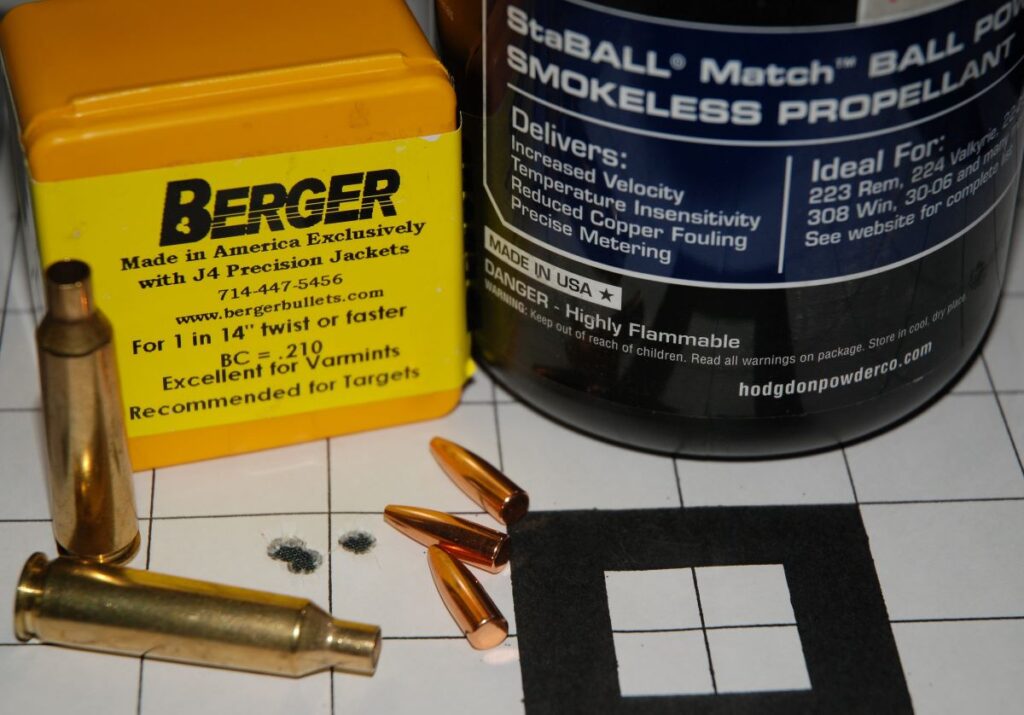 Berger 55-grain bullets and StaBall Match powder delivered the best overall accuracy with this .375-inch group.
Last Shot
Factory ammunition, with an overall average of .771, delivered the type of accuracy expected, whereas my handloads, at 1.020, did not, at least not initially. Not only was the overall average shaky, but also with nary a sub .5-inch group, so was the precision. After considerable afterthought, I decided to organize another round of handloads, this time using a variance in seating depths, powder, powder weights and bullets. The resulting .650 average was a notable improvement. With its .375 precision accuracy, the Berger 55-grain Varmint Match would top my list for predator hunting. It pays to experiment!