

The original press release from the Pacific Salmon Foundation can be found at https://psf.ca/blog/how-tech-is-driving-innovation-for-salmon/.
Advertisement
Monitoring thousands of distinct salmon populations – and the complex conditions that influence their survival – across British Columbia and the Yukon is no small task. Today, emerging tools such as artificial intelligence (AI), microchip tagging, and drone technology are helping researchers overcome long-standing data gaps. As climate impacts intensify and monitoring budgets tighten, these innovations are expanding capacity and delivering the information needed to support effective salmon conservation.
“By combining new technology with strong partnerships, we are better equipped to monitor salmon and their habitats, and to understand where and when we may need to intervene to support their conservation, ” says Dr. Katrina Connors, Senior Director, Pacific Salmon Foundation (PSF). “With thoughtful and strategic use, emerging tools can also strengthen local stewardship and uphold Indigenous sovereignty.”
Advertisement
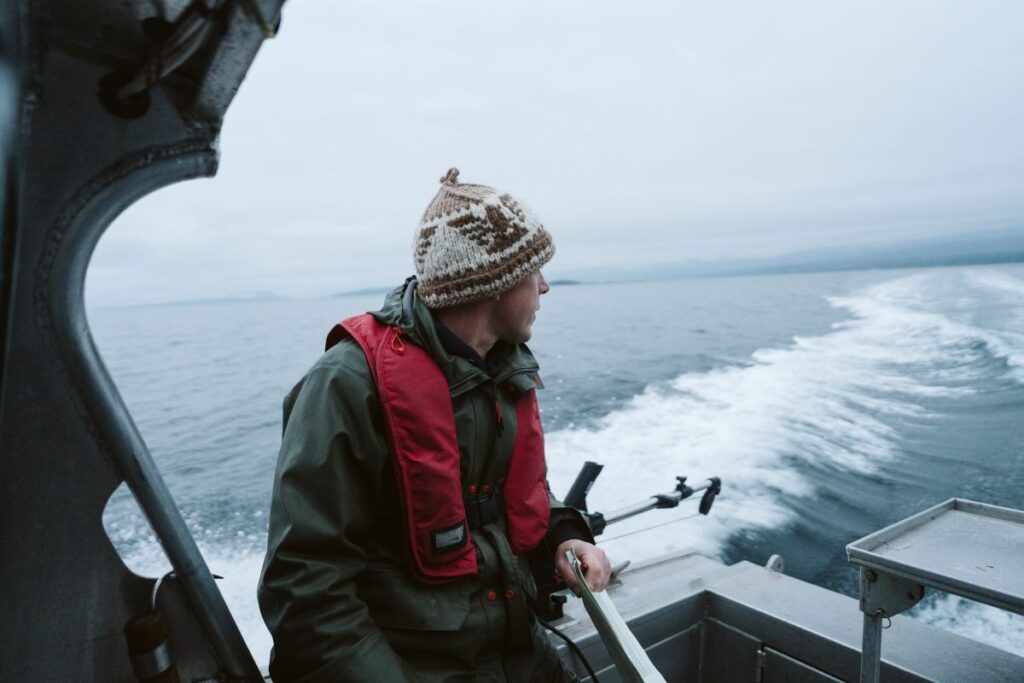 Salmon scientists use research boat to catch and sample fish.
Photo credit: Brandon Deepwell
Below are six ways PSF and its partners are applying technology to strengthen salmon and habitat monitoring.
Advertisement
Using AI To Count Returning Salmon
In partnership with Simon Fraser University, the Wild Salmon Center, Lumax Inc., and several First Nations, PSF is piloting AI-enabled salmon counting systems at 12 monitoring sites throughout BC and Alaska.
These systems integrate video and sonar cameras with computer-vision software that automatically detects and identifies salmon as they migrate upstream to spawn. Since 2020, field teams have gathered hundreds of thousands of hours of footage, enabling near real-time assessments of salmon returns – something previously impossible at this scale.
For the Kitasoo Xai’xais First Nation on BC’s central coast, the technology complements traditional fishing weirs – Indigenous in-river structures used for sustainable harvest – making it possible to monitor salmon in remote locations.
“The Kitasoo Xai’xais are a nation of 350 to 400 people in a very large area. We simply couldn’t get this scale of information on important indicator stocks without the AI tool,” says Christina Service, a biologist with Kitasoo Xai’xais Stewardship Authority.
Tracking Juvenile Salmon At Sea
Why so many young salmon fail to survive their first winter in the ocean has long puzzled scientists. To better understand these losses, researchers are using Passive Integrated Transponder (PIT) tags – tiny chips similar to those embedded in credit cards – to follow salmon throughout their lifecycle.
Since 2020, PSF and the BC Conservation Foundation have tagged more than 450,000 juvenile Chinook, coho, and steelhead. Antenna arrays installed in 11 rivers on Vancouver Island record when tagged fish migrate to sea and when adults return to spawn. By 2025, nearly 3,000 returning adults had been detected.
A newly launched database now allows partners and the public to explore this data by river, species, and age class. The findings are helping pinpoint critical survival bottlenecks and guide conservation actions to where they can make the greatest difference.
A Genetic Window Into Salmon Stress
Fish don’t outwardly display stress the way humans do – but their genes do. Using small, non-lethal gill biopsies, researchers can now examine how salmon respond to environmental pressures such as disease, warm water, or other stressors.
Known as the Fit-Chip, this tool identifies which genes are activated under different conditions, offering a rapid snapshot of fish health. Developed by Dr. Kristi Miller at Fisheries and Oceans Canada with support from PSF, the technology can reveal large-scale patterns linking survival to specific environmental threats.
On the west coast of Vancouver Island, PSF and its partners are combining PIT tagging with Fit-Chip analysis to better understand the pressures facing threatened Chinook salmon.
“By uncovering the challenges young Chinook salmon face and the ultimate fate of those same fish, we’ll gather evidence more directly than ever before about what’s impacting survival,” says Dr. Andrew Bateman, the project lead at PSF.
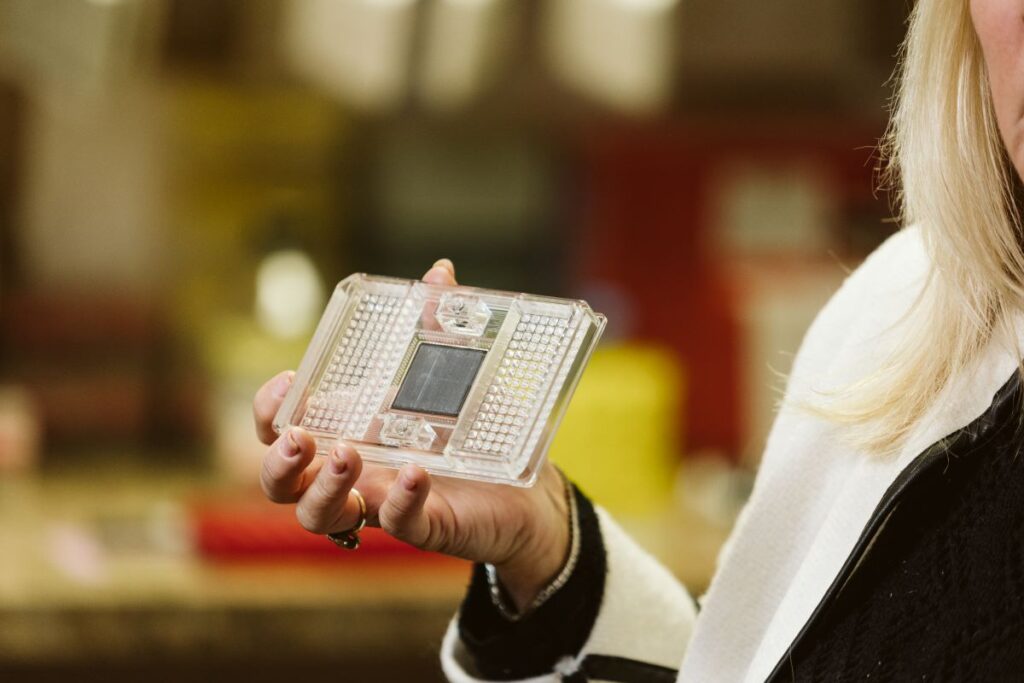 The Fit-Chip used by scientists to check salmon health.
Photo credit: Brandon Deepwell
Monitoring Predators By Drone & AI
To better understand how predators influence salmon populations, First Nations partners, PSF, and the BC Conservation Foundation are working together to monitor seals and sea lions in key salmon rivers on Vancouver Island.
Using drone surveys, camera traps, and underwater detection and mapping tools, teams are tracking predator numbers, movements, and feeding behaviour over time. AI models are also being developed to speed up image review and produce consistent counts across locations.
The long-term goal is to establish a monitoring framework that supports Indigenous-led stewardship and informs evidence-based decisions around seal and sea lion management.
Improving Catch Data Without Added Burden
Collecting accurate harvest data has traditionally required significant time and labour. New technologies are helping improve data quality while reducing strain on fishers and field crews.
On commercial vessels, onboard cameras can now record fishing activity, with AI assisting in identifying species, catch timing, and locations. This enables near real-time analysis of fishing pressure and bycatch.
In recreational fisheries, PSF has partnered with the BC Conservation Foundation, Vancouver Island marinas, and Fisheries and Oceans Canada to transform fish-cleaning stations into valuable data hubs. Motion-activated overhead cameras document species and hatchery fish – identified by clipped adipose fins – while maintaining angler anonymity. Integrated receivers can also detect PIT tags in cleaned fish.
Together, these tools offer a clearer picture of when and where salmon are being caught. PSF is now exploring expanded use of AI to streamline video analysis and better integrate these insights into fisheries management.
Locating Cold-Water Refuges During Heat Extremes
As drought conditions worsen, water temperatures in some BC rivers now exceed 20°C – levels that can be lethal for cold-water fish. Fortunately, groundwater inflows can create cooler pockets known as thermal refuges, where salmon can recover during heat stress.
“It’s similar to air conditioning. When it’s hot out, people move inside to thermoregulate. Salmon do the same thing,” says Auston Chhor, a salmon habitat biologist with Raincoast Conservation Foundation.
PSF has partnered with Dr. Eric Saczuk from BCIT’s Remotely Piloted Aircraft Systems Hub to train 10 Indigenous groups in using thermal drones to map and monitor salmon habitat.
In 2025, the Scw’exmx Tribal Council, Citxw Nlaka’pamux Assembly, and Raincoast Conservation Foundation worked together to identify thermal refuges in the Coldwater River and test methods to protect and expand these critical cold-water areas.
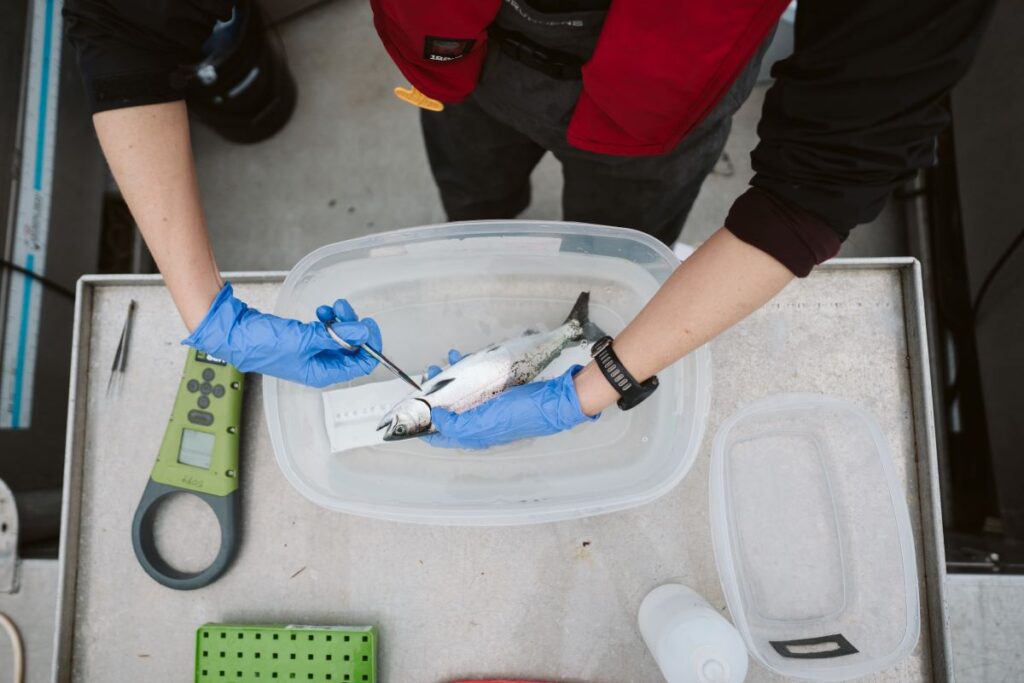 A researcher examines juvenile salmon.
Photo credit: Brandon Deepwell
Salmon Monitoring At A Critical Juncture
Recent research shows that the past decade marked the weakest period on record for salmon monitoring in BC and the Yukon. Yet these emerging technologies have already proven their ability to complement existing methods and partnerships.
As climate pressures mount, sustained monitoring and high-quality data will be essential to guide conservation priorities and recovery efforts.
“At a time when monitoring budgets are under increasing pressure, leveraging the efficiencies provided by technology is key to supporting salmon conservation and driving effective salmon recovery,” says Connors.